
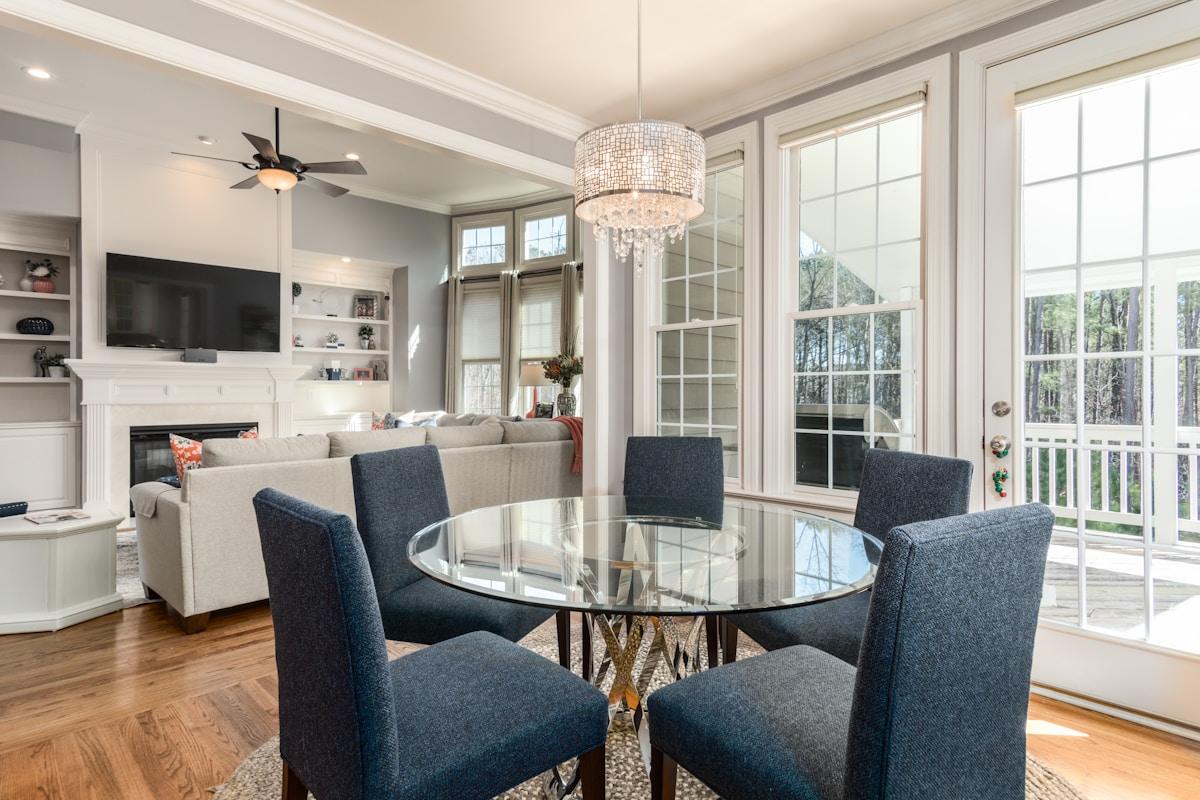
A custom glass table top costs $75 to $500 or more, depending on size, thickness, glass type, and edge finish. For the most common residential projects — a protective glass cover for a dining table or a replacement top for a coffee table — expect to pay $100 to $300 for tempered glass with a polished edge, cut to your exact measurements.
Per-square-foot pricing gives a clearer picture of how costs scale. According to Mannlee Custom Windows, tempered glass runs $12 to $15 per square foot at 1/4-inch thickness, $15 to $20 at 3/8-inch, and $20 or more at 1/2-inch. Edge finishing, shape complexity, and delivery add to the base glass cost. A 36-by-60-inch dining table top in 3/8-inch tempered glass with a flat polished edge typically lands between $200 and $350 installed in the Colfax area.
I'm John, owner of Colfax Glass at 226 N Auburn St in Colfax, CA. We've been cutting custom glass for furniture, desks, and table tops across the Sierra Foothills for over 25 years. Glass table tops are one of our most straightforward projects — fast turnaround, precise cuts, and the result protects your furniture while making any room look more polished. This guide covers 2026 pricing for every common configuration so you know what to expect before you call for a quote.
Bottom line: most homeowners pay $100 to $300 for a custom tempered glass table top. A standard 36-by-60-inch dining table protector in 1/4-inch tempered glass with a flat polished edge costs roughly $125 to $200. Thicker glass, beveled edges, or custom shapes push the price higher.
Glass Table Top Cost by Thickness
Thickness is the single biggest factor in glass table top pricing. Thicker glass costs more per square foot, weighs more (which affects shipping), and requires more time to cut and finish. The right thickness depends on how the glass will be used — as a protective cover sitting on an existing surface, or as a standalone table top supported only at the edges or center.
The table below shows 2026 per-square-foot pricing for tempered glass at each standard thickness, based on data from Mannlee Custom Windows and Lancaster Paint & Glass. These are base glass costs before edge finishing, which adds $3 to $10 per linear foot depending on the edge style.
Pro Tip: if your glass sits directly on a solid table surface (wood, stone, or metal), 1/4-inch tempered glass is sufficient for tables up to 48 inches in any dimension. Once any dimension exceeds 48 inches, step up to 3/8-inch minimum. For glass-only table tops supported only by legs or a pedestal — where the glass IS the table — 1/2-inch is the minimum safe thickness for any size.
| Thickness | Cost per Sq Ft (Tempered) | Weight per Sq Ft | Best Use |
|---|---|---|---|
| 1/8" (3mm) | $9 – $12 | 1.6 lbs | Cabinet shelves, picture frame glass — too thin for table tops |
| 1/4" (6mm) | $12 – $15 | 3.3 lbs | Table protectors over solid wood, small coffee tables, end tables |
| 3/8" (10mm) | $15 – $20 | 4.9 lbs | Dining tables, desks, mid-size coffee tables with full base support |
| 1/2" (12mm) | $20 – $30 | 6.5 lbs | Large dining tables, conference tables, pedestal-base tables with minimal support |
| 3/4" (19mm) | $30 – $45 | 9.8 lbs | Heavy-duty commercial tables, glass-only designs with no solid surface underneath |
How to Choose the Right Thickness for Your Table
Choosing the wrong thickness is the most common mistake homeowners make when ordering a glass table top. Too thin, and the glass flexes under weight or shatters from stress. Too thick, and you overpay for strength you do not need.
The decision comes down to two questions: Is the glass sitting on a solid surface, or is it the surface? And how large is the piece?
A glass table protector — placed on top of an existing wood, stone, or laminate table — carries minimal structural load. The table underneath handles the weight of dishes, elbows, and daily use. The glass just needs to resist scratching, spills, and minor impacts. For this application, 1/4-inch tempered glass works for tables up to about 48 inches in length or diameter. Beyond that, 3/8-inch provides the extra rigidity needed to prevent flex across the wider span.
A standalone glass table top — where the glass rests on legs, a pedestal, or an open frame with no solid surface beneath it — carries the full structural load. According to Demers Glass, 1/2-inch tempered glass is the minimum for standalone dining tables and large coffee tables. Conference tables and pieces exceeding 72 inches in any dimension should use 3/4-inch glass. The extra weight of thicker glass also provides stability — a 36-by-72-inch piece of 1/2-inch tempered glass weighs roughly 100 pounds, which keeps the table planted.
- Glass protector on wood/stone table (up to 48 inches): 1/4-inch tempered — $12 to $15 per square foot
- Glass protector on wood/stone table (over 48 inches): 3/8-inch tempered — $15 to $20 per square foot
- Standalone glass top on legs or pedestal (up to 48 inches): 3/8-inch tempered minimum, 1/2-inch preferred — $15 to $30 per square foot
- Standalone glass top on legs or pedestal (over 48 inches): 1/2-inch tempered minimum — $20 to $30 per square foot
- Large conference or commercial table (over 72 inches): 3/4-inch tempered — $30 to $45 per square foot
- Patio or outdoor table: 3/8-inch or 1/2-inch tempered — same pricing as indoor, but tempered is mandatory for thermal shock resistance in direct sun
Edge Finishing Options and Costs
The edge finish is the second largest cost variable after thickness. Raw-cut glass has a sharp, rough edge that is unsafe for a table top. Every glass table top needs some form of edge treatment, and the type you choose affects both the look and the price.
Edge finishing is priced per linear foot — the total perimeter of the glass piece. A 36-by-60-inch rectangle has a perimeter of 16 linear feet. A 48-inch-diameter round has a perimeter of about 12.6 linear feet. The per-foot cost of edge work ranges from roughly $3 per linear foot for a basic seamed edge up to $10 or more per linear foot for a beveled edge, based on pricing from Glass Genius and regional glass shop averages.
Here is how each edge type compares in terms of appearance, durability, and cost.
| Edge Type | Description | Cost per Linear Foot | Best For |
|---|---|---|---|
| Seamed (sanded) | Lightly sanded to remove sharpness — not polished, slightly rough to the touch | $3 – $4 | Glass that sits in a frame or channel where the edge is hidden |
| Flat polished | Ground flat and polished to a smooth, glossy finish with small 45-degree chamfers top and bottom | $5 – $7 | Most table tops — clean modern look, safe for exposed edges |
| Pencil polished | Rounded edge with a soft curve, polished to a shine — resembles the profile of a pencil tip | $5 – $7 | Coffee tables, kid-friendly surfaces — no sharp corners even on the edge profile |
| Beveled | Angled cut (typically 1 inch wide) ground into the top edge, creating a light-catching facet around the perimeter | $8 – $12 | Formal dining tables, statement pieces — adds visual depth and elegance |
| Ogee | S-shaped decorative profile combining a concave and convex curve — the most ornate standard option | $10 – $15 | Traditional or high-end furniture — visible craftsmanship in the edge detail |
For most residential table tops, flat polished or pencil polished edges offer the best balance of appearance, safety, and cost. At Colfax Glass, flat polished is our most-requested edge for dining table protectors and desk tops. Pencil polished edges are popular for coffee tables and end tables where people rest their arms on the glass edge — the rounded profile is more comfortable than a flat edge.
Beveled edges cost roughly twice as much as flat polished edges per linear foot, but they transform the look of a glass table top. The angled facet catches light and creates a visible border that makes the glass look intentional rather than like an afterthought. If you are ordering a glass top for a formal dining table or a showcase piece of furniture, the bevel is worth the premium.
Cost by Shape: Rectangle, Round, Oval, and Custom
Rectangles and squares are the least expensive shapes to cut because they require only straight cuts with no curve work. Round and oval tops cost more due to the specialized cutting and grinding equipment needed to produce a smooth curve. Custom shapes — racetrack ovals, free-form curves, notched corners for L-shaped desks — add another tier of cost.
The shape premium is typically a percentage markup over the base glass cost, not a separate line item. Expect the following approximate markups over a rectangular piece of the same area and thickness.
Important: all holes, notches, and cutouts must be specified before the glass is tempered. Tempered glass cannot be drilled, cut, or modified after the tempering process. If you need a hole for a patio umbrella pole, a cable pass-through for a desk, or a notch for wall clearance, those details must be on the order from the start. Colfax Glass handles this during the measurement and order process — our custom glass cutting service includes templating for non-standard shapes.
- Rectangle or square: baseline price — straight cuts only
- Round (circle): 10 to 20 percent above baseline — requires radius cutting
- Oval or racetrack: 15 to 25 percent above baseline — compound curves require more finishing time
- Custom shape (notched, L-shaped, free-form): 20 to 40 percent above baseline — requires a template and additional fabrication time
- Holes and cutouts (for cable grommets, umbrella poles, or mounting hardware): $10 to $25 per hole — must be drilled before tempering
Real-World Pricing Examples for Common Table Tops
Pricing tables and per-square-foot numbers are useful for comparison, but most people want to know what their specific project will cost. Here are six common glass table top projects with realistic 2026 pricing based on tempered glass with a flat polished edge, reflecting Northern California glass shop rates.
These examples assume standard clear tempered glass. Frosted, tinted, or Low-E glass adds 15 to 30 percent to the glass cost. Delivery within the Colfax service area is typically included for orders over $150 or adds $25 to $50 for smaller orders.
| Project | Dimensions | Thickness | Approximate Cost |
|---|---|---|---|
| Coffee table protector | 24" x 48" rectangle | 1/4" | $75 – $125 |
| Dining table protector (seats 6) | 36" x 60" rectangle | 1/4" | $125 – $200 |
| Dining table protector (seats 8) | 42" x 72" rectangle | 3/8" | $200 – $325 |
| Round patio table replacement | 48" diameter round | 3/8" | $175 – $275 |
| Office desk top (standalone glass) | 30" x 60" rectangle | 1/2" | $250 – $400 |
| Large dining table (standalone glass on pedestal) | 42" x 84" rectangle | 1/2" | $400 – $600 |
These ranges cover the glass, edge work, and basic delivery. They do not include specialty glass types, beveled edges, or custom shapes, all of which push the price toward the higher end or beyond. A 42-by-84-inch dining table top in 1/2-inch tempered glass with a 1-inch bevel, for example, would run $500 to $750 due to the edge premium on that large perimeter.
For comparison, buying a pre-cut glass table top online from a retailer like Fab Glass and Mirror or a big-box store may appear cheaper upfront, but shipping costs for heavy glass often add $100 to $300 — and you accept the risk of transit damage without local recourse. A local glass shop like Colfax Glass cuts to your exact measurements, finishes the edges in-house, and can deliver or install the piece without the shipping gamble.
Tempered vs. Annealed Glass for Table Tops
Tempered glass is the standard for table tops, and in many applications it is required by code. But understanding why — and when annealed glass might still be an option — helps you make an informed choice.
Tempered glass is heat-treated to be four to five times stronger than annealed (regular) glass of the same thickness. When it breaks, it shatters into small, blunt granules rather than large, sharp shards. This breakage pattern is critical for furniture applications where people sit, lean, and place their hands near the glass edge. Our tempered vs. laminated glass guide covers the manufacturing process and safety properties in detail.
Annealed glass costs roughly $2 to $5 less per square foot than tempered glass, according to Mannlee Custom Windows. On a typical dining table top, that saves $15 to $40. The tradeoff is significant: annealed glass breaks into large, razor-sharp shards that can cause serious injury. It is also weaker under impact and more susceptible to thermal stress cracking from hot dishes or direct sunlight — a real concern for outdoor table tops in the Sierra Foothills where surface temperatures can exceed 130 degrees Fahrenheit on a summer afternoon.
For virtually every residential table top application, tempered glass is the right choice. The small cost premium buys meaningful safety and durability improvements. Annealed glass may be acceptable for a decorative display surface that will never bear weight or sit near people, but those situations are rare.
- Tempered glass: $12 to $35 per square foot depending on thickness — 4 to 5 times stronger than annealed, shatters into safe granules, resists thermal shock
- Annealed glass: $8 to $25 per square foot — lower cost but breaks into dangerous shards, weaker under impact, not recommended for table tops in homes with children or pets
- Laminated glass: $20 to $50 per square foot — holds together when broken (spider-web crack pattern), best for high-value tables where containment matters, 20 to 40 percent premium over tempered
Glass Types Beyond Clear: Tinted, Frosted, Low-E, and Ultra-Clear
Clear tempered glass is the default for most table tops, but it is not the only option. Specialty glass types change the appearance, privacy level, or performance of the table top — at a higher price point.
Frosted glass (also called satin or acid-etched glass) diffuses light and hides the surface underneath. Homeowners use frosted glass table tops to conceal a damaged wood surface while still protecting it, or to create a softer visual on a desk or coffee table. Frosted tempered glass costs 15 to 25 percent more than clear tempered glass of the same thickness. If you want a frosted look on both sides, both surfaces need treatment, which roughly doubles the frosted premium. Our bathroom privacy glass guide covers frosted and patterned glass options in more detail — the same glass types work for table tops.
Tinted glass — available in bronze, gray, green, and blue-green — adds color while reducing light transmission. Bronze and gray tints are the most popular for table tops because they complement wood furniture tones. Tinted tempered glass adds 10 to 20 percent over clear.
Low-iron (ultra-clear) glass eliminates the slight green tint visible in standard float glass, especially noticeable on thicker pieces or at the edge. When you look at the edge of a 1/2-inch clear glass table top, you will see a distinct green color — that is iron content in the glass. Low-iron glass removes this, producing a crystal-clear appearance. Low-iron tempered glass costs 25 to 40 percent more than standard clear tempered glass. It is worth the premium when the glass edge is visible and the clean, colorless look matters to you.
Low-E glass is rarely used for table tops. The metallic coating that reflects infrared heat is designed for windows and building envelopes, not furniture. Skip it for table top applications unless you have a specific solar heat concern for a south-facing sunroom table.
Measuring for a Custom Glass Table Top
Accurate measurements are the foundation of a successful glass table top order. Unlike a window or a door frame with tolerance built into the installation, a table top sits in plain view where a 1/4-inch error is visible and a 1/2-inch error means the glass does not fit.
For rectangular or square tops, measure the length and width at multiple points — furniture is not always perfectly square, especially antique or handmade pieces. Take three measurements across the length and three across the width. If the measurements vary, use the smallest dimension and subtract 1/8 inch from each side for clearance. This ensures the glass does not overhang unevenly or bind against walls or other furniture.
For round tops, measure the diameter at three different angles across the circle. If the table is not perfectly round (many are slightly oval), provide the longest and shortest diameters so the glass shop can cut to the correct profile. Our window measurement guide covers general glass measurement principles — the same precision applies to table tops.
For irregular or custom shapes, the safest approach is a template. Lay kraft paper, poster board, or cardboard over the table surface and trace the exact outline, marking any holes, notches, or rounded corners. Bring the template to the glass shop. At Colfax Glass, we also offer on-site measurement for complex pieces — we will come to your home, measure the table, and create the template.
Pro Tip: before measuring, decide whether you want the glass to sit on top of the table surface or inside a recessed frame or lip. Glass sitting on top should be cut 1/4 to 1/2 inch smaller than the table surface on all sides so the edge does not catch on clothing or create a trip hazard when pulled. Glass sitting inside a recess should be cut 1/8 inch smaller than the recess on all sides for clearance. Getting this detail wrong is the most common reason for re-orders.
- Rectangle or square: measure length and width at three points each — use the smallest dimensions minus 1/8 inch per side
- Round: measure diameter at three angles — provide both longest and shortest if the table is not perfectly circular
- Oval: measure the longest length, widest width, and trace the curve profile on a template
- Custom shape: create a full-size template from kraft paper or cardboard and bring it to the glass shop
- Corner radius: if you want rounded corners instead of sharp 90-degree corners, specify the radius (1 inch and 2 inch are the most common)
- Holes and cutouts: mark exact positions and diameters on the template — these must be specified before cutting and tempering
Glass Table Tops for Outdoor and Patio Use
Patio table glass replacement is one of the most common glass table top orders at Colfax Glass, especially after a Sierra Foothills winter. Temperature swings, UV exposure, wind-blown debris, and the occasional tree branch take a toll on outdoor glass furniture. A cracked or shattered patio table top needs replacement with tempered glass — no exceptions.
Outdoor glass table tops face thermal stress that indoor glass never encounters. A glass surface in direct sun on a Colfax summer afternoon can reach 130 to 150 degrees Fahrenheit on the surface. A cold drink, a sudden rain shower, or shade from a passing cloud drops the surface temperature rapidly. Annealed glass can crack from this thermal shock. Tempered glass handles temperature differentials up to about 300 degrees Fahrenheit without stress fracture, making it the only safe choice for outdoor furniture.
For patio tables, 3/8-inch tempered glass is the minimum recommended thickness. Most patio tables use a metal or wicker frame with the glass sitting in a recessed lip, which provides edge support. If the frame has a center hole for an umbrella pole, the glass needs a matching hole — typically 2 to 2-1/2 inches in diameter. Remember, this hole must be drilled before tempering.
Sierra Foothills homeowners should also consider the weight of the glass as a wind resistance factor. A 48-inch round piece of 3/8-inch tempered glass weighs about 60 pounds — heavy enough to stay put in moderate wind. A 1/4-inch piece of the same size weighs only 40 pounds and is more likely to shift or blow off in a gust. The extra $30 to $50 for 3/8-inch over 1/4-inch buys meaningful wind stability in addition to strength.
How to Protect Wood Furniture with a Glass Top
The most popular reason homeowners order a custom glass table top is to protect a wood dining table or heirloom furniture piece from scratches, water rings, heat marks, and daily wear. A glass protector preserves the wood surface while keeping it visible — unlike a tablecloth that hides the grain and finish you paid for.
For wood protection, 1/4-inch tempered glass in clear with a flat polished or pencil polished edge is the standard specification. The glass sits directly on the wood surface. To prevent the glass from sliding and to protect the wood finish from direct glass-to-wood contact, use small clear rubber bumper pads at each corner and at the midpoint of each long edge. These pads are inexpensive (a pack of 20 costs a few dollars at any hardware store) and they create a thin air gap that prevents moisture from getting trapped between the glass and wood.
Without bumper pads, condensation from cold glasses or temperature changes can create a moisture layer between the glass and wood that eventually damages the finish. In the Sierra Foothills, where daily temperature swings of 30 to 40 degrees are common in spring and fall, this moisture issue is more pronounced than in milder climates. The bumper pads solve it completely.
- Use 1/4-inch tempered glass for tables up to 48 inches — step up to 3/8-inch for larger tables
- Place clear rubber bumper pads at all corners and midpoints to prevent sliding and moisture trapping
- Cut the glass 1/4 to 1/2 inch smaller than the table surface on each side for a clean overhang-free look
- Clean the wood surface and apply a fresh coat of furniture polish before placing the glass — whatever is under the glass is what you will see for months
- Avoid placing the glass directly over an unfinished or unsealed wood surface — trapped humidity can cause the wood to warp or discolor over time
Getting a Custom Glass Table Top in the Colfax Area
Glass table tops are a core part of what we do at Colfax Glass. Whether you need a protective cover for a family dining table, a replacement top for a shattered patio table, or a custom glass desk surface for a home office, our custom glass cutting service handles the full process: measurement, glass selection, cutting, edge finishing, and delivery.
Turnaround for standard rectangular or round table tops in common thicknesses is typically three to five business days from order. Custom shapes, specialty glass types (frosted, tinted, low-iron), and thicker pieces (1/2-inch and above) may take one to two weeks depending on material availability. We stock 1/4-inch and 3/8-inch clear tempered glass in-house for the fastest possible turnaround.
For tempered and laminated glass specifications — including safety code requirements, strength ratings, and specialty applications — we provide guidance during the quoting process. If your project involves unusual sizes, very thick glass, or glass-only table designs where the piece carries structural load, a glass and glazing consultation ensures the specification is right before we cut.
Colfax Glass serves homeowners and businesses throughout the I-80 corridor: Colfax, Auburn, Grass Valley, Nevada City, Foresthill, Loomis, Rocklin, Roseville, and Sacramento. Request a free quote or call 530-545-1385 to get started on your glass table top project.