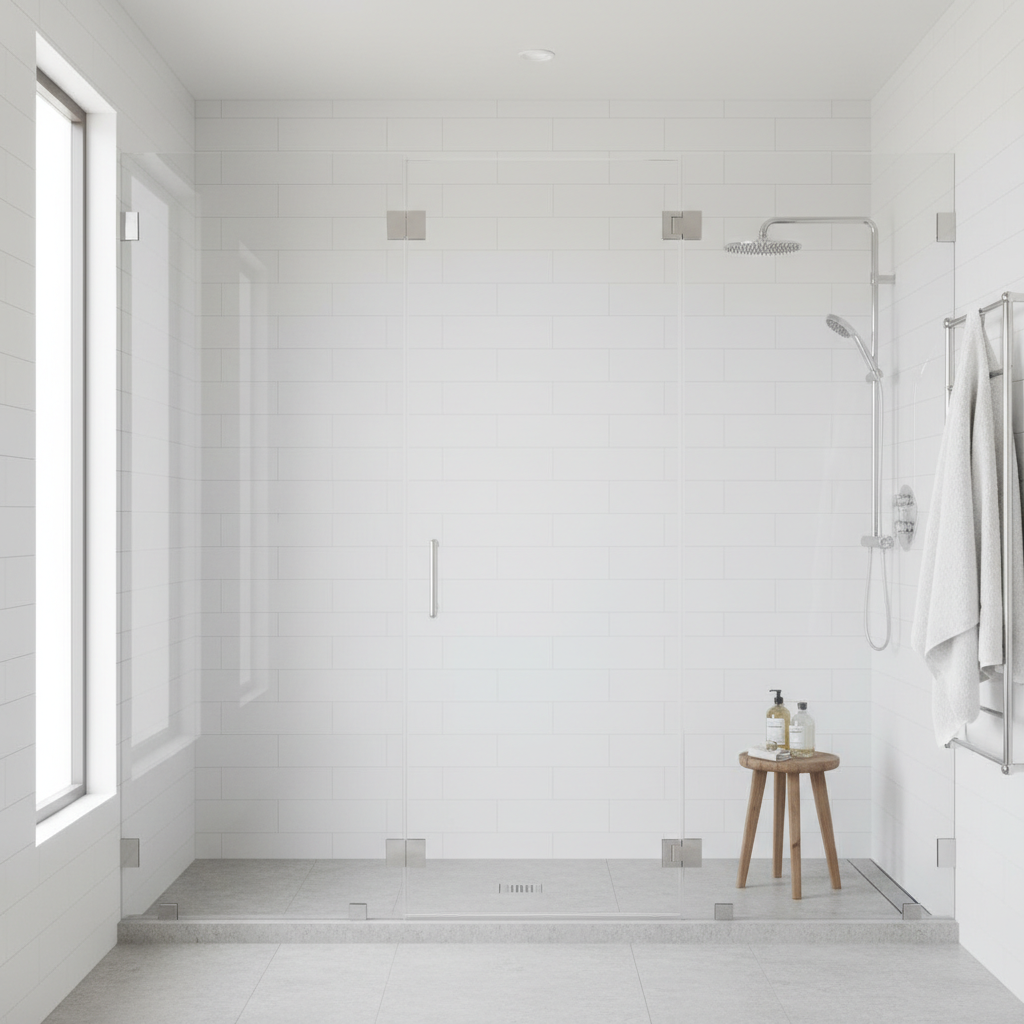
A couple in Loomis was finishing up their master bathroom remodel last fall. Beautiful new tile, new vanity, a frameless shower enclosure we'd just installed. One problem — the large window next to the shower stared directly at the neighbor's deck. Clear glass wasn't going to work. The wife asked me a question I hear on almost every bathroom project: "What kind of glass gives us privacy without making the bathroom feel like a cave?"
That's the real tension with bathroom privacy glass. You need to block the view, but you don't want to kill the natural light that makes a bathroom feel clean and open. According to the National Association of Home Builders, bathroom remodels rank among the top three home improvements for return on investment (NAHB, 2025), and the glass you choose for windows and shower enclosures is one of the most visible decisions you'll make. The answer depends on how much privacy you need, how much light you want to keep, and what you're willing to spend.
This guide compares seven bathroom privacy glass types side by side — frosted, obscure, rain, reeded, patterned, tinted, and smart glass — with real pricing, light transmission data, and California building code requirements for wet areas. Whether you're replacing a clear bathroom window or choosing glass for a new shower enclosure, you'll know exactly what each option costs and how it performs.
TL;DR: Frosted glass ($8–$15/sq ft) blocks 95% of visibility while transmitting 70–85% of light — the best all-around bathroom choice. Obscure and textured options ($10–$25/sq ft) add visual depth. Smart glass ($50–$100/sq ft) switches from clear to opaque on demand. California building code requires tempered safety glass in all bathroom wet areas. This guide compares 7 privacy glass types by cost, light transmission, and privacy level.
What Types of Privacy Glass Work in Bathrooms?
Seven privacy glass types cover the full range from partial obscurity to total opacity, with material costs ranging from $8 to over $100 per square foot. According to HomeGuide's 2025 glass pricing data, frosted and obscure glass remain the most commonly installed privacy options in residential bathrooms nationwide (HomeGuide, 2025). Each type handles privacy differently — some scatter light, some distort images, and one switches between clear and opaque on command.
**Frosted glass** uses an acid-etched or sandblasted surface to create a uniform matte finish. It blocks shapes and details while allowing soft, diffused light through. This is the workhorse of bathroom privacy — predictable, affordable, and available everywhere in tempered versions. Most homeowners end up here.
**Obscure glass** is factory-molded with patterns like hammered, flemish, or aquatex that distort visibility at varying levels. Some patterns are lightly textured and still show color and movement. Others are deeply patterned and nearly opaque. The privacy level depends entirely on which pattern you pick.
**Rain glass** features vertical lines that mimic rainfall on a windowpane. It's popular for shower enclosures and street-facing bathroom windows because it looks elegant while providing moderate privacy. Straight-on visibility is higher than frosted, but from angles, it's quite private.
**Reeded glass** has parallel ridged lines — vertical fluting that creates an architectural look. It's trending heavily in 2025 and 2026 for showers and partitions. According to Houzz's 2025 Bathroom Trends Study, reeded and fluted glass saw a 34 percent increase in project mentions year over year (Houzz, 2025). Privacy is good straight-on but drops at angles.
**Patterned glass** includes decorative textures like glue chip, seedy, and water glass that add character while providing varying levels of privacy. These are the choice when aesthetics matter as much as function — a bathroom that needs to look interesting, not just private.
**Tinted glass** uses color — gray, bronze, or blue-green — to reduce visibility through light absorption. It provides moderate daytime privacy but works less effectively at night when interior lights are on. Think of it as a supplement rather than a standalone privacy solution.
**Smart glass** (switchable) uses electrochromic or PDLC technology to transition from clear to opaque with an electric current. Flip a switch and the glass goes from transparent to frosted in under a second. It's the high-end option for homeowners who want flexibility without blinds or curtains.
How Much Does Bathroom Privacy Glass Cost?
Privacy glass ranges from $8 to over $100 per square foot depending on the type, with frosted glass offering the best value for most bathroom applications. According to pricing data from HomeGuide and Modernize, standard frosted tempered glass runs $8 to $15 per square foot for materials, while smart glass starts at $50 per square foot before installation (HomeGuide, 2025; Modernize, 2025). Installation adds $50 to $150 per opening for windows and more for shower enclosures.
Here's what each type actually costs when you're looking at a typical bathroom window or shower panel. I've included privacy ratings and light transmission percentages so you can compare apples to apples.
These are material costs only. Installation adds $50–$150 per opening for window glass swaps and $200–$500+ for shower enclosure panels depending on configuration and hardware. Always get installed pricing — material cost alone doesn't tell the full story.
| Glass Type | Cost per Sq Ft | Full Window (3'×4') | Shower Panel (3'×6') | Privacy Level | Light Transmission |
|---|---|---|---|---|---|
| Frosted | $8–$15 | $96–$180 | $144–$270 | 4/5 | 70–85% |
| Obscure | $10–$20 | $120–$240 | $180–$360 | 3–4/5 | 60–80% |
| Rain | $12–$22 | $144–$264 | $216–$396 | 3/5 | 65–80% |
| Reeded | $15–$28 | $180–$336 | $270–$504 | 3–4/5 | 60–75% |
| Patterned | $10–$25 | $120–$300 | $180–$450 | 2–4/5 | 50–80% |
| Tinted | $10–$18 | $120–$216 | $180–$324 | 2/5 | 40–70% |
| Smart glass | $50–$100+ | $600–$1,200+ | $900–$1,800+ | 5/5 | 5–75% (adjustable) |
How Does the Cost Play Out on a Real Project?
A couple in Auburn called me about upgrading three bathroom windows from clear to frosted. The windows were standard 3-by-4-foot double-hung units, about 9 years old, in vinyl frames that were still in excellent shape. No rot, no warping, no seal failures. They didn't need new windows — they needed new glass.
We did glass-only swaps with frosted tempered IGUs in the existing frames. Total cost: $540 for all three windows. The alternative — full window replacement with factory-frosted glass — would have run about $2,400. Sound frames saved them $1,860 and two days of construction mess.
That's the first question I always ask when someone wants privacy glass in an existing bathroom: what condition are the frames in? If the frames are solid and the hardware works, a glass-only swap at $150 to $400 per window is almost always the right call. You get brand-new factory-sealed privacy glass without tearing out perfectly good frames.
For new construction or full remodels, privacy glass is just a line item in the window or shower order. The upcharge from clear to frosted is typically $3 to $8 per square foot at the manufacturer level. From clear to reeded or rain, expect $5 to $15 per square foot more. That's a small premium for something you'll look at — or more accurately, not look through — every day.
Which Privacy Glass Blocks the Most Without Killing Natural Light?
Frosted glass offers the best privacy-to-light ratio of any option — roughly 95 percent visual privacy with 70 to 85 percent light transmission. According to glass performance data from Cardinal Glass Industries, acid-etched frosted glass transmits significantly more visible light than tinted or heavily patterned alternatives while providing near-total obscurity (Cardinal Glass Industries, 2024). That's why it's been the default bathroom privacy glass for decades.
The tradeoff between privacy and light is real, though, and it varies by type. Tinted glass cuts light the most aggressively — down to 40 percent transmission for darker bronzes and grays — while only providing moderate privacy. Heavily patterned glass can drop to 50 percent transmission while still allowing some shape recognition through the pattern. Frosted glass hits the sweet spot because the etched surface scatters light uniformly rather than absorbing it.
Here's a detail most people don't think about: nighttime performance. During the day, privacy glass works great because exterior light overwhelms interior details. But at night, when your bathroom lights are on and it's dark outside, the equation flips. Shadows and silhouettes become more visible through lighter textures like rain and reeded glass. Frosted and deep obscure patterns handle this much better because they diffuse light more evenly across the entire surface.
Distance and viewing angle matter too. A second-story bathroom window with rain glass is effectively 100 percent private — nobody's close enough or at the right angle to see anything. A ground-floor window six feet from the sidewalk? That same rain glass might show movement and color. For ground-level bathrooms near walkways, frosted is the safer choice every time.
Want to test before you commit? Hold a sample piece of the glass you're considering at arm's length in front of a lamp. If you can make out the shape of the bulb, you'll see shapes through the window at night. If you only see a soft glow, you're in good territory.
What Does California Building Code Require for Bathroom Glass?
California Building Code Section 2406 requires tempered or laminated safety glass in all bathroom wet areas — no exceptions for decorative or privacy glass. According to the International Code Council, safety glazing is mandatory in any glass installation within 60 inches of a water source in a bathroom (ICC, 2024). This applies to every type of privacy glass discussed in this guide.
Here are the specific requirements. Any glass within 60 inches of a water source — shower, tub, or sink — must be tempered or laminated safety glass. All shower enclosure glass must be tempered, no exceptions. Bathroom windows within 60 inches of the floor must use safety glazing if they're also within 60 inches horizontally of a wet area. Glass in doors, including shower doors, must be tempered.
What does this mean for your privacy glass choice? Every option you pick has to come in a tempered version. The good news: all seven types listed in this guide are available tempered. Frosted, rain, and reeded glass are commonly stocked in tempered by major distributors. Exotic patterns — like certain glue chip or seedy textures — may require custom tempering, which adds 2 to 3 weeks of lead time and 15 to 25 percent to the glass cost.
I've seen remodelers install non-tempered decorative glass in showers because they liked the pattern. That's a code violation and a safety hazard. If the glass breaks, it shatters into jagged shards in a wet, slippery space where people are barefoot. Always confirm your glass is tempered — look for the small etched stamp in one corner. If there's no stamp, don't step behind it.
| Code Requirement | What It Means in Practice |
|---|---|
| Glass within 60" of water source | Must be tempered or laminated — applies to shower, tub, and sink areas |
| All shower enclosure glass | Must be tempered — no exceptions, including privacy patterns |
| Bathroom windows near floor + wet area | Safety glazing required if within 60" of floor AND 60" of water |
| Glass in bathroom doors | Must be tempered — includes shower doors, entry doors with glass |
| Privacy glass tempering | All 7 types available tempered; exotic patterns may need custom order (2–3 weeks) |
Can You Add Privacy Glass to Existing Bathroom Windows?
Yes, and you've got three options ranging from a $30 DIY fix to a $1,500 full replacement. The best choice depends on your frame condition, budget, and how permanent you want the solution to be. According to This Old House, glass-only swaps in existing frames save homeowners 40 to 60 percent versus full window replacement when the frame is structurally sound (This Old House, 2026).
**Option 1: Privacy window film ($3–$8 per square foot, DIY).** Adhesive film applied directly to existing glass. It's the cheapest option and available in frosted, etched, and decorative patterns at any home improvement store. The downsides are real, though. Film peels and bubbles in humid bathroom environments, especially near showers where steam hits the window daily. It doesn't match the look or feel of real frosted glass up close. And it's not a permanent solution — expect to replace it every 3 to 5 years in a bathroom.
**Option 2: Glass-only swap ($150–$400 per window).** Replace just the glass unit — the insulated glass unit, or IGU — in the existing frame with a frosted or obscure tempered IGU. This keeps your frame, hardware, and trim intact. It's the best value when the frame is in good shape, and the result is indistinguishable from a factory-ordered privacy window. This is the option I recommend most often.
**Option 3: Full window replacement ($500–$1,500+ per window).** A brand-new window with built-in privacy glass. This makes sense when the frame is damaged, rotted, or warped, or when you're upgrading from old aluminum to vinyl or fiberglass for energy efficiency. If the frame needs work anyway, doing the glass and frame together is more cost-effective than fixing the frame and swapping the glass separately.
A homeowner in Foresthill wanted obscure glass in two bathroom windows last spring. The wood frames were only 8 years old and in excellent condition — no rot, no operational issues. We did glass-only swaps with obscure tempered IGUs for $320 each, installed. That's less than half the cost of new windows. She got the privacy she wanted without touching anything else in the bathroom.
Which Privacy Glass Works Best for Shower Enclosures?
Three options dominate the shower enclosure market: frosted, rain, and reeded glass. According to a 2025 survey by the National Kitchen and Bath Association, privacy glass options now account for roughly 30 percent of all residential shower glass orders, up from 18 percent five years ago (NKBA, 2025). Rain glass is currently the most requested pattern for showers in 2026 based on what I'm seeing across our project pipeline.
**Frosted** delivers uniform privacy and is the easiest to live with day to day. Water spots and soap film show less on frosted glass than on clear, which means less frequent cleaning. It works for full enclosures — three-panel walk-ins, neo-angle corners — and for single fixed panels next to a shower opening.
**Rain glass** adds vertical texture that looks like water running down the surface. It's slightly less private than frosted, especially at close range, but the aesthetic is hard to beat. Most homeowners choosing frameless shower doors in 2026 are asking about rain glass before anything else.
**Reeded glass** gives an architectural, linear look with strong vertical fluting. It's trending hard in modern bathroom designs — you'll see it in every design magazine right now. Privacy is good from straight-on viewing but drops off at side angles, which is worth considering if your shower is positioned where someone walking past the open bathroom door could see the glass from an angle.
Here's something we've been doing more of lately: combination panels. Many homeowners choose frosted on the lower two-thirds of the shower panel and clear on the upper third. You get full privacy where it counts and an open, airy feel at the top where visibility doesn't matter. We fabricate this as a single banded panel — not two pieces joined together — so there's no seam to leak or collect mold.
One more note on shower glass privacy: the thickness matters. Shower enclosure glass should be 3/8-inch or 1/2-inch tempered regardless of which privacy type you choose. Thicker glass shows the texture and pattern better, and it meets California safety code without question.
Is Smart Glass Worth It for Bathrooms?
Smart glass uses PDLC (polymer-dispersed liquid crystal) technology to switch from clear to opaque with an electric current. Flip a switch or tap your phone, and the glass goes from transparent to frosted in under a second. It's genuinely impressive technology. But at $50 to $100-plus per square foot for the glass alone, plus $200 to $500 for electrical work, it's five to eight times the cost of frosted glass for the same-size opening.
Let's run the numbers on a real scenario. A 3-by-4-foot bathroom window in smart glass costs $800 to $1,500 installed, including wiring. That same window in frosted glass: $150 to $300 installed. For a shower panel, you're looking at $1,200 to $2,200 for smart glass versus $250 to $450 for frosted. According to Grand View Research, the global smart glass market is growing at 8.3 percent annually (Grand View Research, 2024), but the residential segment remains a small fraction of that — most smart glass goes into commercial buildings.
The pros are real. You get total flexibility — clear when you want maximum light, opaque when you want privacy. No blinds or curtains to maintain, clean, or replace. And there's an undeniable wow factor that adds perceived value in high-end bathrooms.
The cons are equally real. The cost is five to eight times higher than frosted for the same result 90 percent of the time. You need an electrical connection to the glass, which means running wire during construction or a disruptive retrofit. Availability in tempered versions for wet areas is more limited than standard privacy glass. And if the electrical component fails, the glass gets stuck in one state — usually opaque, which is the lesser evil, but still not what you paid for.
Here's my honest take after installing smart glass in about five bathrooms over the last three years. Every single one was a high-end remodel where the homeowner specifically wanted it and had the budget for it. Not one of them needed it — frosted or rain glass would have solved the privacy problem at a fraction of the cost. For 95 percent of bathroom projects, frosted or rain glass does the job. Smart glass is a luxury, not a necessity. Cool? Absolutely. Practical for most budgets? Not even close.