
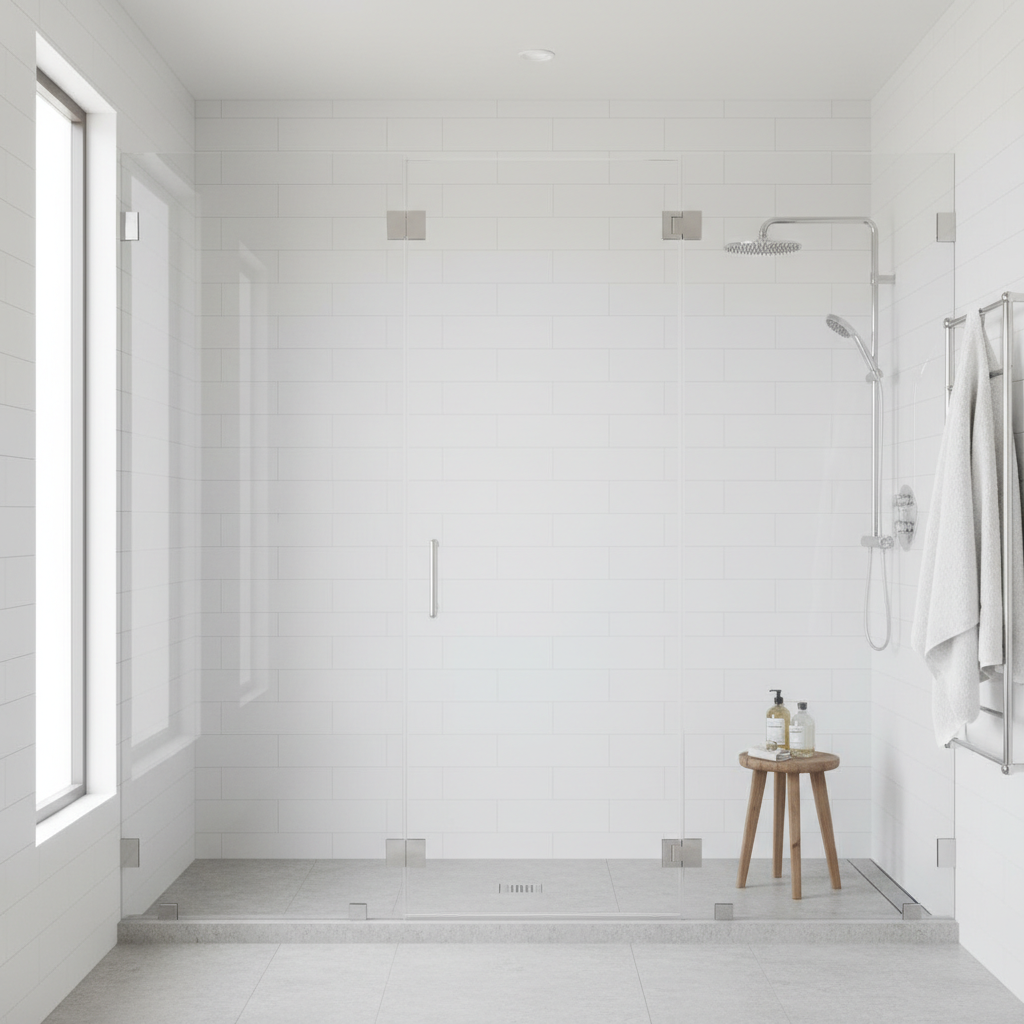
Frameless shower doors are the better long-term investment for most California homeowners doing a bathroom remodel, but framed doors are the smarter choice when the budget is tight or the bathroom walls are significantly out of square. That is the honest answer after 25 years of installing both types across the Sierra Foothills and Northern California coast.
The decision between frameless and framed is not just about looks — though the visual difference is significant. It also affects your daily cleaning routine, how long the hardware lasts, how the door handles imperfect wall conditions, and what the project will cost. There is also a third option, semi-frameless, that splits the difference in ways that make it a surprisingly practical choice for certain bathroom layouts.
John at Colfax Glass has installed thousands of shower enclosures across Colfax, Auburn, Grass Valley, Nevada City, Foresthill, and the coastal communities near Crescent City and Brookings. This comparison covers the real differences he sees in the field — not manufacturer marketing claims, but how these enclosures actually perform in foothill and coastal homes.
The Core Difference: How Much Metal Surrounds the Glass
A frameless shower door is a thick panel of tempered glass — typically 3/8-inch or 1/2-inch — mounted with minimal hardware directly to the wall or to an adjacent fixed glass panel. All shower glass must meet the federal safety glazing standard CPSC 16 CFR 1201, which requires tempered or laminated safety glass in shower and bathtub enclosures. There is no metal frame around the perimeter of the glass. Hinges, clamps, and a small handle are the only hardware visible. The glass itself provides the structural rigidity.
A framed shower door uses thinner glass — usually 1/4-inch tempered — that sits inside a metal frame channel on all four sides. The frame provides the structural support, which is why the glass can be thinner and lighter. The frame is typically aluminum, available in finishes like chrome, brushed nickel, or matte black.
Semi-frameless falls between the two. It uses a metal channel along the top and bottom of the enclosure (and sometimes the sides of the fixed panel) but leaves the door itself without a frame. Glass thickness is usually 5/16-inch to 3/8-inch. You get some of the visual openness of frameless with the wall-tolerance benefits of framed.
The most common misconception John encounters: homeowners assume that frameless means no hardware at all. Frameless enclosures still use hinges, clamps, and mounting hardware — the difference is that the glass panels do not have a metal frame around their edges. The hardware is minimal and low-profile, not absent.
Cleaning and Maintenance: The Day-to-Day Difference
This is where frameless pulls ahead the most in John's experience, and it is the factor most homeowners underestimate before installation.
Framed shower doors have metal channels along every edge of the glass. Water, soap residue, and mineral deposits collect in these channels, especially along the bottom track where water sits. Cleaning inside the frame channels requires a toothbrush or narrow brush and some patience. In hard water areas — which includes most Sierra Foothills communities — mineral buildup in the frame channels becomes a persistent maintenance chore. Mildew growth inside the channels is common in bathrooms without strong ventilation.
Frameless doors eliminate almost all of those collection points. There is no bottom track, no top channel, and no side rails where buildup accumulates. A squeegee after each shower and a weekly wipe-down with a mild glass cleaner is typically all that is needed. If you add a protective coating like EnduroShield (around $100 to $150), the cleaning effort drops even further.
Semi-frameless is a middle ground — less frame to clean than fully framed, but the channels that remain still collect deposits. The bottom track on a semi-frameless bypass or sliding configuration will need the same attention as a framed track.
Over the lifespan of the enclosure, the cleaning difference is significant. Homeowners who are honest about how much time they want to spend maintaining their shower typically prefer frameless once they understand the daily difference.
If your home is on well water in the Grass Valley, Foresthill, or Nevada City area, the cleaning advantage of frameless is even more pronounced. Hard well water leaves mineral deposits faster, and those deposits are much easier to manage on open glass surfaces than inside metal frame channels.
Cost Comparison: What You Will Actually Pay
Frameless costs more than framed. That is the straightforward reality, and the gap is significant enough to be a real factor in most bathroom remodel budgets. According to This Old House, framed shower doors run $600 to $1,200 while frameless enclosures range from $1,100 to $5,000 depending on size and customization. Based on projects Colfax Glass has completed across the Sierra Foothills and coastal service area, here are the typical installed cost ranges for a standard tub-shower or alcove shower opening.
The cost difference between a basic framed unit and a standard frameless enclosure is roughly $800 to $1,300 for the same opening size. That gap pays for thicker glass, precision measurement, custom fabrication, and higher-quality hardware. Whether that premium is worth it depends on your budget, how long you plan to stay in the home, and how much you value the reduced cleaning effort and updated appearance.
| Door Style | Installed Cost Range | Glass Thickness | What Is Included |
|---|---|---|---|
| Framed sliding bypass | $400 – $1,200 | 1/4" tempered | Two-panel sliding door, full frame, standard hardware, installation |
| Semi-frameless sliding | $800 – $1,600 | 5/16" – 3/8" tempered | Sliding door with partial frame, upgraded hardware, installation |
| Frameless hinged door + panel | $1,200 – $2,500 | 3/8" tempered | Custom-cut door and fixed panel, premium hinges and clamps, installation |
| Frameless hinged door + panel (premium) | $1,800 – $3,500 | 1/2" tempered | Thicker glass, premium hardware finish, glass coating, installation |
Durability and Lifespan
Both frameless and framed enclosures last a long time when installed properly with quality materials. The failure modes are different, and that difference matters for understanding long-term ownership costs.
Framed enclosures fail most commonly at the frame itself. The metal channels corrode over time, especially in humid bathrooms with poor ventilation. The rubber gaskets inside the channels that cushion the glass degrade and lose their seal, allowing water to escape the enclosure. The sliding tracks on bypass doors wear from the rollers riding back and forth and can eventually bind or derail. These are 10 to 15 year problems in typical use, sooner in high-humidity coastal environments like Crescent City.
Frameless enclosures fail most commonly at the hardware — specifically the hinges. A heavy glass door swinging on two hinges multiple times per day puts sustained stress on those mounting points. Quality hinges from manufacturers like C.R. Laurence are rated for this load and last 15 to 20 years or more under normal use. Budget hinges from generic suppliers may begin to sag or lose their hold within 5 to 8 years. The glass itself does not degrade — tempered glass holds up indefinitely in a shower environment.
In John's experience, a frameless enclosure installed with quality hardware outlasts most framed enclosures because there are fewer moving parts and fewer components susceptible to corrosion. The glass and premium hardware simply do not wear out the way frame channels, gaskets, and sliding tracks do.
The single most important durability decision on a frameless enclosure is the hinge quality. John uses C.R. Laurence or HMI hinges on every frameless installation — brands rated for the weight of the glass and engineered for daily wet-environment use. Saving $40 on budget hinges leads to a sagging door within a few years.
Resale Value: What Buyers Expect
Bathroom remodels rank among the highest-ROI home improvements, and the shower enclosure is the most visible element in the room. According to the 2025 JLC Cost vs. Value Report, a midrange bathroom remodel in California recoups approximately 85.8 percent of its cost at resale — the fourth highest return of any state and well above the 80 percent national average. The National Association of Home Builders confirmed that bathroom remodeling was the single most common home improvement project in 2025, and buyers notice the details.
Frameless glass shower enclosures are now a standard expectation in updated bathrooms in the mid-range and above price categories. In the Sierra Foothills market, where homes in Auburn, Grass Valley, and Roseville regularly sell in the $400,000 to $800,000 range, a dated framed shower door or a shower curtain in the primary bathroom is a noticeable negative during showings. A clean frameless enclosure signals a maintained, updated home.
Framed enclosures do not hurt resale the way a shower curtain does, but they do not generate the same positive impression as frameless. For homeowners planning to sell within 5 years, the cost premium of frameless is partly recovered through the remodel's contribution to sale price and buyer perception. For homeowners staying long-term, the daily cleaning advantage and personal enjoyment are the primary return.
Wall Conditions: Where Framed Has a Real Advantage
This is the one area where framed enclosures genuinely outperform frameless from a practical standpoint.
Frameless glass panels need to make clean contact with the wall surface along their entire mounting edge. If the wall is out of plumb — meaning it leans forward or backward rather than being perfectly vertical — the glass will not sit flush. The gap between the glass and the wall has to be sealed with silicone, and if the gap is more than about 1/4 inch, it looks poor and compromises the seal. Older homes in Auburn's historic district, Nevada City, and many of the foothill communities built before the 1990s commonly have walls that are 1/4 to 1/2 inch out of plumb across a 6-foot shower opening.
Framed enclosures accommodate this because the metal frame can be shimmed, adjusted, and sealed against uneven surfaces without the visual compromise. The frame channels hide the gap. For bathrooms with significantly out-of-square conditions where wall repair is not part of the project scope, framed or semi-frameless is the more practical choice.
John assesses wall conditions during every measurement visit. If the walls are too far out of plumb for a clean frameless installation, he will say so and recommend the option that will look and perform best given the actual conditions. Forcing frameless into a space that needs framed is a mistake that shows up immediately and does not get better over time.
John's advice: if your heart is set on frameless but the walls are out of plumb, consider having the tile contractor address the wall condition before scheduling the glass measurement. Furring strips, backer board, or re-tiling the glass contact wall can bring it into tolerance for frameless. This adds cost and time but produces the best result.
Which Should You Choose?
After installing thousands of shower enclosures across the foothills and coast, John's recommendation comes down to three factors: budget, wall condition, and cleaning tolerance.
Choose frameless if your budget supports it, the walls are in reasonable condition, and you want the cleanest look with the least ongoing maintenance. This is the right call for most bathroom remodels where the homeowner plans to stay in the home or is preparing it for sale.
Choose framed if the budget is tight, the walls are significantly out of square, or the shower is a secondary bathroom where appearance is less of a priority. A well-installed framed enclosure with quality hardware is a perfectly legitimate product — it just requires more cleaning and has a shorter hardware lifespan than frameless.
Choose semi-frameless if you want some of the visual openness of frameless but the walls are not ideal for a fully frameless installation, or if the budget falls between the two. Semi-frameless is an underrated option that John installs more often than most homeowners expect to choose.
Regardless of style, the quality of the installation matters more than the frame style. A well-installed framed enclosure will outperform a poorly installed frameless one every time. Start with a measurement visit so the recommendation is based on your actual bathroom, not a generic comparison.
- Frameless: best for updated bathrooms, resale prep, homeowners who prioritize low maintenance, and walls in good plumb condition
- Framed: best for tight budgets, secondary bathrooms, and openings with significantly out-of-square walls
- Semi-frameless: best for moderate budgets, walls with minor irregularities, and homeowners who want partial visual openness