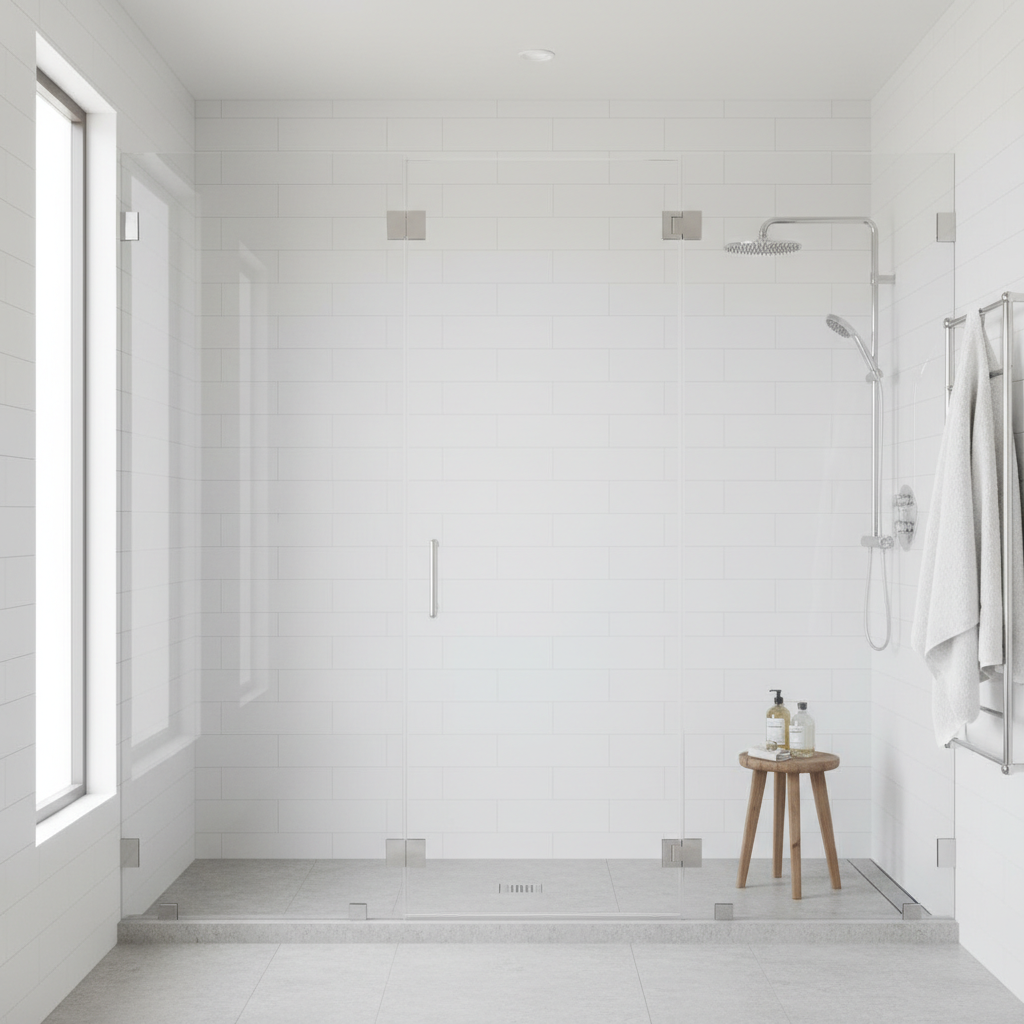
A standard frameless shower door with one fixed panel in 3/8-inch tempered glass costs $1,200 to $2,500 installed in California as of 2026. That range covers the majority of alcove and tub-to-shower conversion projects with a single hinged door, one fixed glass panel, quality hardware, and professional installation. Larger enclosures, thicker glass, premium hardware finishes, and glass coatings push the upper end to $3,500 or beyond.
Those numbers come from actual project data across Colfax Glass installations in the Sierra Foothills and Northern California coast — not national averages or manufacturer list prices. California labor rates, custom glass fabrication costs, and material pricing all run higher than the national averages you will find on home improvement websites, so national data consistently understates what a California homeowner will actually pay.
John, owner of Colfax Glass at 226 N Auburn St in Colfax, has been pricing and installing shower glass across the foothill corridor for over 25 years. The pricing in this guide reflects what his customers have paid on real projects — and what factors moved those prices up or down.
National home improvement websites typically cite frameless shower door costs of $900 to $1,500. Those numbers are based on national averages that include lower-cost markets. In California, where skilled glazing labor runs higher and custom glass fabrication is standard, expect to pay 20 to 40 percent above national average figures for comparable quality.
Cost by Configuration: What Each Setup Actually Runs
The shower enclosure configuration is the biggest cost driver. A simple single-door setup costs significantly less than a multi-panel walk-in enclosure because of the glass quantity, hardware count, and fabrication complexity involved.
The table below shows realistic installed price ranges for the most common frameless configurations Colfax Glass installs across the Sierra Foothills and coastal service area. All prices include measurement, custom glass fabrication, hardware, installation, and cleanup.
The most popular configuration Colfax Glass installs is a single hinged door with one fixed panel — the door + one fixed panel setup. It covers the large majority of standard alcove showers and represents the best balance of cost, appearance, and functionality.
| Configuration | Glass Panels | Installed Cost | Best For |
|---|---|---|---|
| Single door only (no fixed panel) | 1 | $800 – $1,500 | Narrow openings (24" – 30") with tile or stone on both sides |
| Door + one fixed panel | 2 | $1,200 – $2,500 | Standard alcove showers, most common configuration |
| Door + two fixed panels (return panel) | 3 | $1,800 – $3,200 | Corner showers, openings with a half-wall or pony wall |
| Neo-angle enclosure | 3 | $2,000 – $3,500 | Corner-mounted diamond-shaped showers in smaller bathrooms |
| Walk-in / doorless (fixed panels only) | 1 – 3 | $900 – $2,800 | Open shower designs with no door to operate or clean |
| Full corner enclosure (door + 2 – 3 panels) | 3 – 4 | $2,500 – $4,500+ | Large custom showers with multiple glass walls |
What Drives the Price Up (and What Keeps It Down)
Within any configuration, several factors move the final price up or down. Understanding these variables before you get a quote helps you make tradeoff decisions that fit your budget.
Glass thickness is the first variable. Three-eighths-inch tempered glass is the standard for frameless enclosures and is included in the base price ranges above. Upgrading to 1/2-inch glass adds $150 to $400 to the total depending on the number and size of panels. The thicker glass has a more substantial edge profile and a slightly more premium feel, but 3/8-inch is not a compromise — it is the industry standard for quality frameless installations. All frameless shower glass must be tempered safety glass per CPSC 16 CFR 1201, the federal safety glazing standard that covers shower doors and enclosures.
Hardware finish affects cost modestly. Standard finishes like polished chrome and brushed nickel are typically included in the base price. Premium finishes like matte black, oil-rubbed bronze, and satin brass carry a $50 to $150 upcharge depending on the number of hardware pieces. The finish does not affect durability — all quality hardware from brands like C.R. Laurence and HMI is engineered for wet environments regardless of finish. According to This Old House, frameless enclosures range from $1,100 to $5,000 nationally due to their thicker glass requirements and custom mounting hardware.
Glass coatings add $100 to $400 to the project. EnduroShield runs about $100 to $150, Diamon-Fusion about $120 to $200, and factory-applied ShowerGuard about $200 to $400 above uncoated glass. In hard water areas — which includes most Sierra Foothills communities — a coating is a worthwhile investment that pays back in reduced cleaning effort over the life of the enclosure.
Custom glass shapes add cost because they require additional fabrication. Notches cut around shower benches or half-walls, angled cuts for sloped ceilings, and curved glass panels all increase the fabrication price. A standard rectangular panel is the most economical to produce.
- Keeps cost down: standard rectangular panels, 3/8-inch glass, chrome or brushed nickel hardware, no coating, standard opening size
- Pushes cost up: 1/2-inch glass, matte black or bronze hardware, glass coating, custom notches or angles, larger-than-average openings, multiple panels
- Biggest single cost factor: the number of glass panels — more panels means more glass, more hardware, and more installation time
Frameless vs. Semi-Frameless vs. Framed: Cost Comparison
If your budget is the primary constraint, understanding the cost gap between frame styles helps you decide where to land. The cost difference between a basic framed unit and a standard frameless enclosure is roughly $800 to $1,300 for the same size opening. That gap pays for thicker glass, precision custom measurement and fabrication, and higher-quality hardware. Whether that premium is worth it depends on your priorities — if reduced cleaning effort, modern appearance, and resale value matter, frameless pays back over time. If the budget needs to go further, a well-installed framed or semi-frameless enclosure is a perfectly legitimate choice.
| Style | Typical Installed Cost | Glass Thickness | Annual Maintenance Cost |
|---|---|---|---|
| Framed sliding bypass | $400 – $1,200 | 1/4" tempered | Higher — frame channels require regular deep cleaning |
| Semi-frameless | $800 – $2,000 | 5/16" – 3/8" tempered | Moderate — some channels to clean, fewer than framed |
| Frameless (3/8" glass) | $1,200 – $2,500 | 3/8" tempered | Lowest — squeegee and weekly wipe-down, no channels |
| Frameless (1/2" glass) | $1,500 – $3,500 | 1/2" tempered | Lowest — same maintenance as 3/8" frameless |
Where the Money Actually Goes: Cost Breakdown
Understanding how a frameless shower door quote breaks down helps you evaluate whether a price is fair and where savings are possible.
For a typical frameless door-plus-panel installation in 3/8-inch tempered glass at a total installed price of around $1,800, the approximate cost breakdown looks like this: custom tempered glass panels account for roughly 35 to 40 percent of the total. Hardware — hinges, clamps, handle, and any header bar or support clips — accounts for 15 to 20 percent. Professional installation labor accounts for 30 to 40 percent. The remaining 5 to 10 percent covers measurement, silicone and supplies, and cleanup.
Labor is the component that varies most between quotes. Tempered glass — required for all shower enclosures under CPSC 16 CFR 1201 — is approximately four times stronger than standard annealed glass and shatters into small, blunt granules instead of dangerous shards (Wikipedia: Tempered Glass). A lower labor rate does not necessarily mean a better value — shower glass installation is precision work where the measurement accuracy and mounting technique directly determine whether the door hangs level, swings correctly, and seals properly. An enclosure installed by an experienced glazier with 20 minutes of careful shimming and alignment will outperform one hung in 10 minutes by someone less experienced, even if the glass and hardware are identical.
Be cautious of quotes that are significantly below the ranges in this guide. Low pricing on frameless enclosures usually means thinner glass than spec, budget hardware that will sag within a few years, or an installer who is not spending enough time on precision measurement and alignment. Ask for the specific glass thickness and hardware brand in writing before comparing quotes.
| Cost Component | Percentage of Total | Typical Dollar Range |
|---|---|---|
| Custom tempered glass (fabrication + delivery) | 35 – 40% | $630 – $720 |
| Hardware (hinges, clamps, handle, support bars) | 15 – 20% | $270 – $360 |
| Installation labor | 30 – 40% | $540 – $720 |
| Measurement, silicone, supplies, cleanup | 5 – 10% | $90 – $180 |
How to Get an Accurate Quote
Online shower door calculators and national averages are useful for setting general expectations, but the only way to get an accurate price for your specific project is an in-home measurement. Every shower opening is different — wall conditions, tile type, curb height, ceiling height, and the specific configuration you want all affect the final number.
Colfax Glass provides free in-home measurements for all shower enclosure projects. During the visit, John measures the opening at multiple points (because walls are rarely perfectly plumb), assesses the tile and wall condition, discusses your preferences for glass thickness, hardware finish, and coating, and gives you a written quote with the exact installed price — not a range.
When comparing quotes from different installers, make sure each quote specifies the glass thickness, hardware brand and finish, whether a glass coating is included or extra, and whether the price covers measurement, installation, silicone, and haul-away of packaging. A quote that says 'frameless shower enclosure installed' without specifying these details is not a complete quote and makes apples-to-apples comparison impossible.
Colfax Glass serves the full Sierra Foothills corridor — Colfax, Auburn, Grass Valley, Nevada City, Foresthill, Loomis, Rocklin, Roseville, and Sacramento — as well as coastal communities near Crescent City, CA and Brookings, OR. Contact us through the website or call the shop at 226 N Auburn St in Colfax to schedule a free measurement.
Ways to Save Without Cutting Corners
If the frameless price for your project exceeds the budget, there are smart ways to bring the number down without sacrificing quality or ending up with a product you will regret.
Stick with 3/8-inch glass instead of upgrading to 1/2-inch. The performance difference is almost entirely aesthetic — both are strong, safe, and durable. Saving $150 to $400 here is a meaningful reduction with no functional tradeoff.
Choose a standard hardware finish. Chrome and brushed nickel are typically included in the base price. Matte black and bronze finishes look great but add $50 to $150 that can be saved if the budget is tight.
Keep the glass shape simple. Rectangular panels without notches, angles, or curves are the most economical to fabricate. If your shower design allows a straight panel without custom cuts, that simplicity saves money.
Consider semi-frameless as a middle ground. You get much of the visual openness of frameless at a lower price point, and the minimal frame channels are a reasonable cleaning tradeoff for the savings.
Skip the glass coating and add it later. EnduroShield and similar aftermarket coatings can be applied at any time — you do not have to decide at installation. If the budget is tight now, you can add a coating in six months when funds allow. The exception is ShowerGuard, which must be factory-applied before installation.
- Choose 3/8-inch glass over 1/2-inch: saves $150 – $400 with no functional compromise
- Pick chrome or brushed nickel hardware: saves $50 – $150 versus premium finishes
- Keep panels rectangular: avoids custom fabrication upcharges for notches or angles
- Consider semi-frameless: saves $400 – $800 versus comparable frameless configurations
- Defer the glass coating: add EnduroShield or Diamon-Fusion later when budget allows