
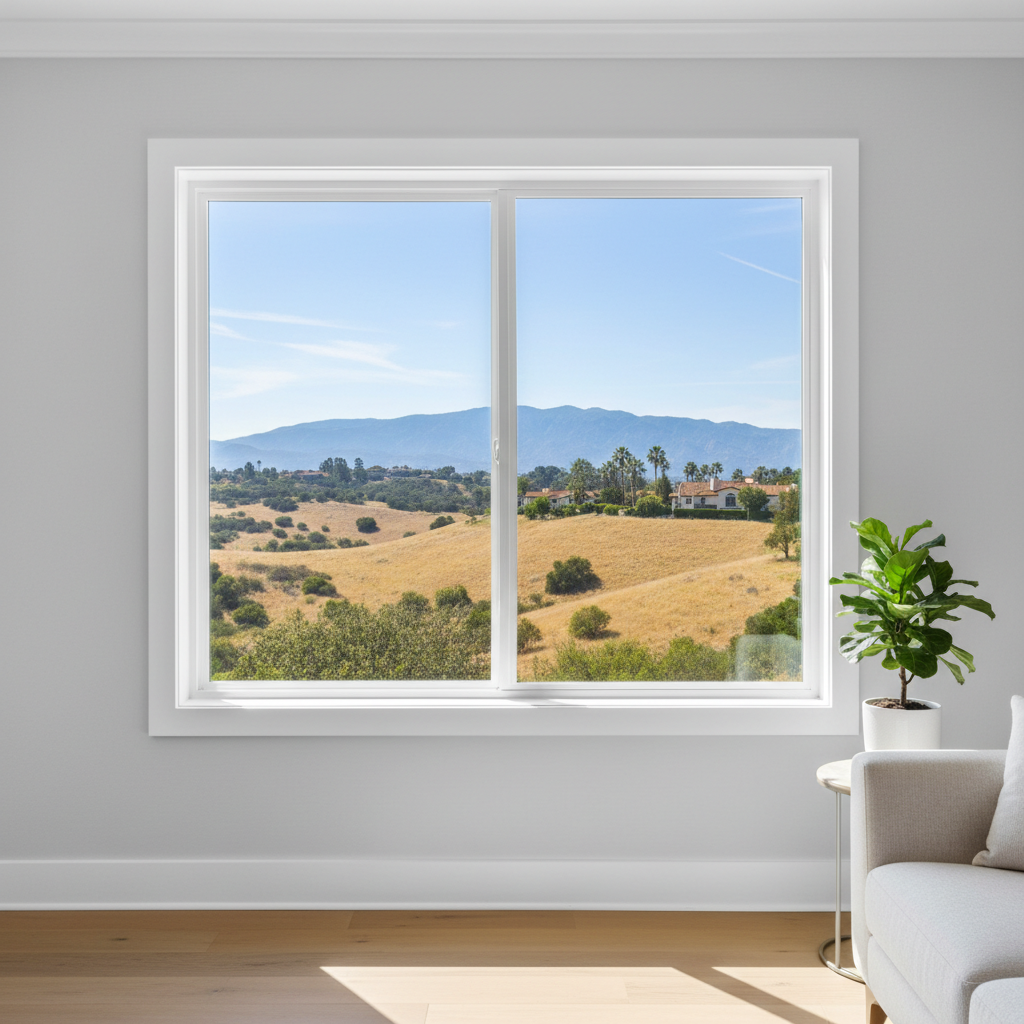
Most windows last 20–25 years — and up to 50 years with proper care, according to This Old House — but Sierra Foothills homes take more punishment than average: triple-digit summers, hard winter freezes at elevation, and wildfire smoke that degrades seals faster than coastal climates. A window that would quietly last 30 years in Sacramento may be showing serious failure by year 18 in Grass Valley or Foresthill. The question homeowners ask most often is whether they can get away with a repair or whether the window needs to come out entirely.
Here are the 7 signs John and the Colfax Glass team see most often that mean it's time to replace, not repair.
- Condensation trapped between the panes of a dual-pane unit
- Drafts you can feel with the window fully closed
- Difficulty opening, closing, or locking the window
- Outside noise has gotten noticeably louder through the glass
- Energy bills that keep climbing without another clear cause
- Visible rot, cracks, or water stains on the frame or sill
- Windows that are single-pane or were installed before 1990
Sign #1: Condensation Between the Panes
If you see a hazy film, streaks, or trapped condensation inside a dual-pane window — between the two layers of glass, not on the interior surface — the insulating seal has failed. Manufacturers fill the space between the panes with argon or krypton gas during production. When the seal breaks down, that gas escapes and moist outside air enters. The moisture then condenses on the inner glass surfaces where you cannot wipe it away.
This is one of the most common calls Colfax Glass receives from homeowners in Colfax, Auburn, and Grass Valley, and it is especially prevalent in foothill homes because the extreme daily temperature swings — 40 to 50 degrees between morning lows and afternoon highs — put far more mechanical stress on window seals than milder valley climates do. Wildfire smoke seasons have made the problem worse in recent years: fine particulates work into weatherstripping and frame joints and accelerate seal degradation.
Can you repair a failed dual-pane seal? Technically, some companies offer glass-unit replacement (swapping just the insulated glass unit without touching the frame). But the labor cost often lands within $100 to $150 of a full retrofit replacement window, and the underlying cause — a frame and sash that have already gone through enough thermal cycling to break one seal — has not been addressed. In most cases, replacing the window is the smarter financial move.
Verdict: Replace.
Sign #2: Drafts Even When the Window Is Closed
Hold your hand near the edge of the sash on a cold December night or a hot July afternoon. If you can feel air moving, the window is leaking — and that air movement translates directly into higher heating and cooling costs year-round.
Drafts through a closed window have three common causes: failed weatherstripping, a warped sash or frame that no longer seats properly, or an installation that was never adequately air-sealed in the first place. Weatherstripping alone is worth replacing if the frame is otherwise sound and the window operates correctly. But if the frame or sash has warped — which is common in wood-frame windows in foothill homes that cycle through wet winters and dry summers — weatherstripping replacement is a temporary patch. The geometry problem that created the gap will continue to worsen.
According to the U.S. Department of Energy, heat gain and heat loss through windows are responsible for 25 to 30 percent of residential heating and cooling energy use. In Sierra Foothills homes that run heating and air conditioning hard for long stretches, that percentage translates to real money — often $200 to $400 per year that better windows eliminate.
Sign #3: Difficulty Opening, Closing, or Locking
A window that requires significant force to open, sticks at the same spot every time, or will not latch securely is telling you something about its structural condition. Casement windows with crank operators that no longer engage properly, double-hung windows that slide unevenly, and sliding windows that jump their tracks are all signs of frame deformation or hardware failure.
The distinction that determines repair versus replacement is whether the problem is in the hardware or in the frame itself. A broken crank operator, a worn latch, or a seized balance spring in a double-hung window can often be repaired at reasonable cost — these are mechanical parts that can be sourced and swapped. But if the sash corners have separated, the frame has racked out of square, or moisture has gotten into a wood frame and caused swelling and rot, no amount of hardware work will correct the underlying issue. Locked-out latches in a rotted frame are a security vulnerability in addition to a comfort problem.
Higher-elevation foothill communities — Foresthill, Grass Valley, Nevada City — see more of this kind of failure because the freeze-thaw cycling in winter is severe enough to work moisture into frame joints and expand them incrementally over years. What starts as a window that takes a little extra force to close ends up as a window that cannot be secured.
Verdict: Repair if hardware only. Replace if frame is deformed or rotted.
Sign #4: Outside Noise Has Gotten Noticeably Louder
Windows degrade acoustically as well as thermally. If the neighborhood sounds louder than it used to — road noise, neighbor activity, or wind — and nothing else has changed, the glass itself may have micro-cracks or the glazing compound may have hardened and separated from the frame, breaking the acoustic seal.
Dual-pane windows have a Sound Transmission Class (STC) rating that describes how much noise they block. A standard single-pane window has an STC of around 27. A quality dual-pane window with laminated glass can reach STC 35 to 40. An older dual-pane unit with a failed seal or compromised glazing compound can perform well below its original rating, and a single-pane window at any age provides minimal noise isolation.
For homeowners near Highway 49, Interstate 80, or in Crescent City neighborhoods near the port, acoustic degradation through aging windows is a real quality-of-life issue, not just an energy problem. Replacing failed units with laminated glass dual-pane windows restores both thermal and acoustic performance in one project.
Verdict: Replace if acoustic performance has declined noticeably.
Sign #5: Your Energy Bills Keep Climbing
Your HVAC system runs harder when windows are failing, and your utility bill records that fact whether or not you make the connection. If your heating costs in January have increased by 15 to 20 percent over three years and nothing else has changed — same thermostat settings, same occupancy, no new appliances — windows are a logical place to look.
The most direct test is a comparison: do certain rooms feel harder to heat or cool than others? A room with southern or western exposure that becomes unbearably hot in July despite closed windows is usually suffering from glass that has lost its Low-E coating effectiveness. A north-facing bedroom that stays cold no matter how high you set the heat often has a seal failure or single-pane window that is conducting cold directly into the room.
According to ENERGY STAR, replacing old single-pane windows with ENERGY STAR certified windows lowers household energy bills by an average of up to 13 percent nationwide, saving an average of $295 per year in heating and cooling costs. Homeowners who replace significantly degraded or single-pane windows with dual-pane Low-E argon units typically report heating and cooling bill reductions of 15 to 25 percent. On a Sierra Foothills home spending $2,400 per year on energy, that is $360 to $600 in annual savings — and a window project often pays back within 7 to 10 years in energy savings alone, before accounting for comfort and resale value.
Sign #6: Visible Damage — Rot, Cracks, or Water Stains
Physical damage to a window frame is the clearest sign of all. Soft or spongy wood on the interior sill, paint that peels repeatedly in the same spot below the window, dark staining on drywall around the frame, or visible cracking in the frame exterior — these are not cosmetic problems. They are evidence that water has gotten past the window system and is working on the surrounding wall assembly.
Rot in a wood frame spreads. What looks like a small soft spot in the sill today is a larger structural problem in two or three years. Beyond the window itself, water intrusion that reaches the framing inside the wall can lead to mold growth in wall cavities, damage to insulation, and eventually structural compromise to the rough framing and sheathing around the opening. In foothill homes that see significant rain in winter followed by hot dry summers, that moisture cycles into and out of damaged framing, accelerating the deterioration.
Cracked glass — even a small crack — is a security and safety issue in addition to a thermal one. If a window is broken or severely cracked, see our emergency glass repair guide for how to secure the opening and what to do next. Cracked glass in a single pane can be replaced without replacing the whole window if the frame is sound. But cracked glass in a dual-pane unit means the sealed unit is compromised and needs replacement as an assembly. Water staining on the interior sill or below the window on the wall usually means the window has been leaking long enough to saturate the surrounding materials. In that case, full-frame replacement — removing the window, inspecting and repairing the rough framing and sheathing, and installing a new window with proper flashing — is the correct approach.
Verdict: Replace. Address the surrounding damage at the same time.
Sign #7: Your Windows Are Single-Pane or Pre-1990
Single-pane windows have a U-factor of roughly 1.0 or higher, meaning they conduct heat almost as efficiently as no window at all. A quality dual-pane Low-E window has a U-factor of 0.25 to 0.30 — the lower the U-factor, the better the insulation, as explained by the DOE's energy performance ratings guide. That difference is not marginal — it is the difference between a wall that actively fights the weather and one that barely slows it down.
In California, new residential construction has been required to meet increasingly stringent energy codes under Title 24 for decades. Single-pane windows cannot meet current Title 24 requirements for any California climate zone. While there is no law requiring you to upgrade existing single-pane windows on a house you are not selling or significantly renovating, they represent a significant energy liability — and a real disclosure concern at resale.
Homes built before 1990 with original aluminum single-pane windows are the most common candidate for whole-house replacement projects in the Colfax and Auburn market. These homes were built before modern energy codes and often have windows that are now 35 to 45 years old, well past any reasonable service life expectation.
California Title 24 requires any permitted window replacement to meet current energy code standards for the applicable climate zone. Even if you are replacing windows without pulling a permit, installing single-pane or non-Low-E windows in a foothill home is a decision that will work against you at every utility bill and at resale. The incremental cost of Low-E glass over standard glass is small — typically $20 to $50 per window — and the performance difference is substantial.
Repair vs. Replace: How to Decide
The honest answer is that most window problems homeowners worry about fall into a clear category once you look at them in person. Hardware failures, weatherstripping wear, and minor operational issues are usually worth repairing. Seal failures, frame rot, structural damage, and single-pane glass are almost always better served by replacement. The table below covers the most common scenarios John sees in the field across the Sierra Foothills and Northern California coast.
| Issue | Can You Repair? | Better to Replace? | Why |
|---|---|---|---|
| Broken glass (single pane) | Yes | Sometimes | Glass replacement is straightforward if the frame is sound; if the frame is aging or damaged, it makes sense to replace the whole window while you have it open |
| Failed double-pane seal (foggy) | Rarely | Yes | The sealed glass unit cannot be re-sealed reliably; glass-unit-only replacement often costs nearly as much as a full retrofit replacement window, without addressing the frame |
| Damaged frame (minor) | Yes | No | Small cracks or chips in a structurally intact frame can be filled and sealed; not every imperfect frame needs replacement |
| Damaged frame (rot or structural) | No | Yes | Rot spreads and weakens the surrounding wall assembly; full-frame replacement is the only correct fix, and the surrounding framing should be inspected at the same time |
| Hardware failure (latch or crank) | Yes | No | Latches, crank operators, and balance springs are replaceable parts; hardware repair is cost-effective when the frame and glass are in good condition |
| Draft from weatherstripping | Yes | Only if frame is deformed | New weatherstripping is a legitimate repair when the frame is square and seats correctly; if the frame has warped so the sash cannot seat, replacement is necessary |
| Single-pane in extreme climate | No | Yes | There is no repair that upgrades single-pane glass to dual-pane performance; full replacement is the only path to meaningful energy improvement |
When to Call Colfax Glass
If you are looking at one or more of these signs in your home right now, the most useful thing you can do is call us for an in-person look. I have been doing this work in the Sierra Foothills for over 25 years, and I have seen enough foothill homes to give you an honest answer in person about whether a repair makes sense or whether replacement is the right call. I am not going to recommend replacement if a repair is genuinely the better option for your situation.
Colfax Glass serves homeowners throughout the foothill corridor — Colfax, Auburn, Grass Valley, Nevada City, Foresthill, Rocklin, Roseville, Lincoln, and El Dorado Hills — as well as coastal communities near Crescent City and Brookings, Oregon. Assessments are free. There is no cost or obligation for me to come out and look at your windows and tell you what I think.
Call us at the shop at 226 N Auburn St in Colfax, or reach out through the website to schedule a time. If replacement is the right call, I will give you a written, itemized quote with the specific product and glass package I recommend for your elevation and exposure — not a vague range pulled from a website.