
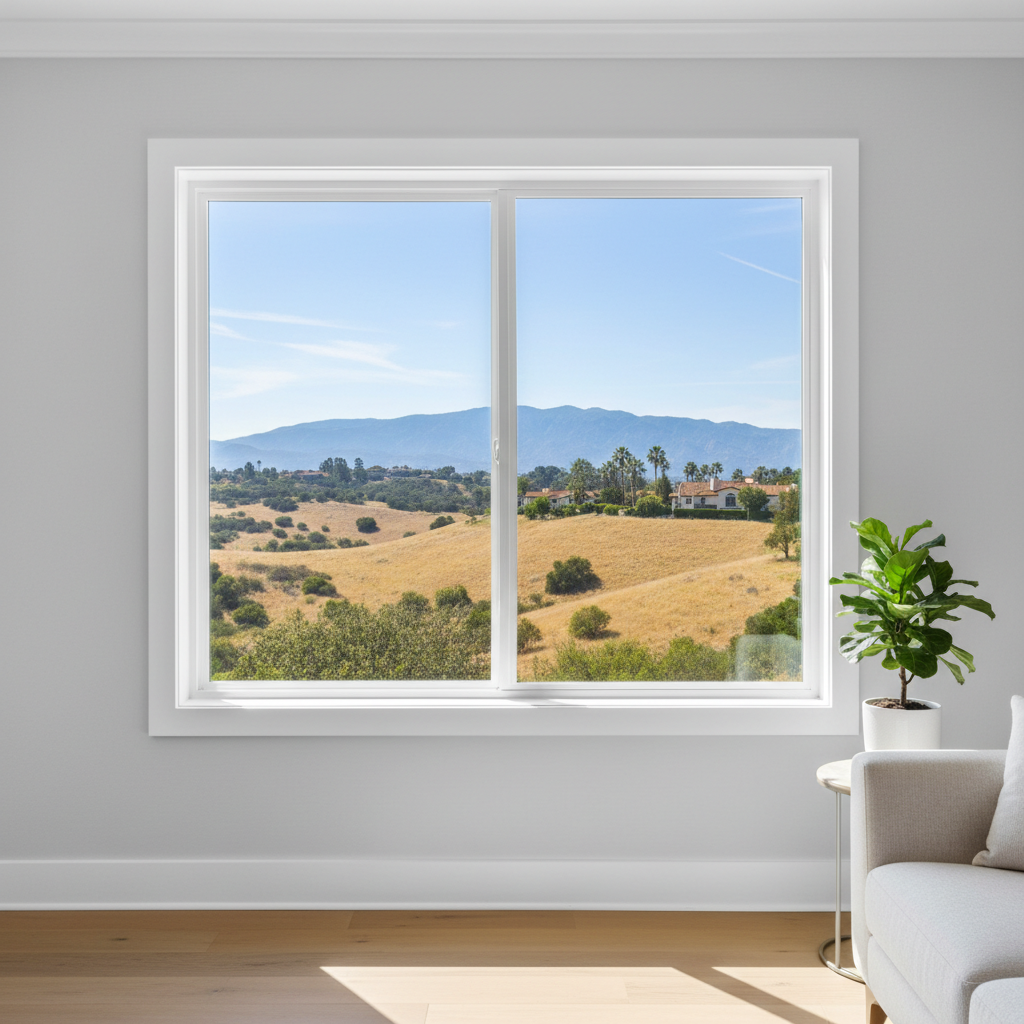
Every summer I get calls from homeowners in Auburn and Colfax who are tired of their west-facing rooms turning into saunas by 3 PM. Their windows are functional — no failed seals, no drafts, no visible damage — but the glass lets in so much solar heat that the AC runs nonstop from June through September. Full window replacement would fix the problem, but at $500 to $1,200 per window, it's hard to justify when the existing windows still work.
That's where window film comes in. A quality solar control film applied to existing glass can drop the Solar Heat Gain Coefficient (SHGC) from around 0.70 on uncoated single-pane glass down to 0.28 — a reduction of up to 78% of incoming solar heat (3M, 2025). The DOE estimates that 25 to 30% of residential heating and cooling energy use is attributable to windows (U.S. Department of Energy, 2025). Film addresses that directly without tearing anything out.
I'm John, owner of Colfax Glass, and I've been working with glass in the Sierra Foothills for over 25 years. Window film isn't something we install ourselves — we're a glass shop, not a tinting company — but I've worked alongside enough film installers and replaced enough filmed windows to know what works, what doesn't, and when film is the right call versus when you should skip it and go straight to new windows. This guide covers film types, real costs, performance data, and a decision framework for foothills homeowners.
TL;DR: Residential window film costs $7-$15 per square foot installed, reduces solar heat gain by up to 78%, blocks 99%+ of UV rays, and lasts 10-20 years. Ceramic and spectrally selective films deliver the best heat rejection without heavy tinting. Film makes financial sense when your existing windows are structurally sound but lack solar control coatings. If your windows have failed seals, frame damage, or don't meet Title 24 requirements, replacement is the better investment.
How Does Window Film Reduce Heat?
Window film works by reflecting and absorbing solar radiation before it enters your living space. The key metric is SHGC — Solar Heat Gain Coefficient — which measures the fraction of solar energy that passes through glass on a scale from 0 to 1. Lower numbers mean less heat getting through.
Standard single-pane clear glass has an SHGC around 0.70 to 0.86. That means 70 to 86% of the sun's heat energy passes straight through. Even basic double-pane clear glass only brings that down to about 0.56 to 0.70. Adding a solar control film drops the number dramatically. A quality ceramic film can bring an uncoated double-pane window down to an SHGC of 0.25 to 0.35 — performance comparable to factory-installed low-E coatings.
The film achieves this through three mechanisms. First, it reflects a portion of solar infrared radiation back outside. Second, the metallic or ceramic particles in the film absorb infrared energy before it can reach the interior glass surface. Third, the film blocks UV radiation — the wavelengths responsible for fading furniture and flooring. The Skin Cancer Foundation certifies films that block 99% or more of UV-A and UV-B rays, and most professional-grade residential films carry this seal (SCF, 2025).
The International Window Film Association (IWFA) reports that properly installed solar film can reduce cooling costs by up to 30% (IWFA, 2025). That lines up with what I've seen in practice — homeowners with large south- and west-facing windows in the foothills consistently report noticeable drops in their summer PG&E bills after film installation.
One clarification worth making early: window film and Low-E glass coatings work on the same principle — reflecting infrared radiation — but factory Low-E is a microscopically thin metallic oxide layer applied during glass manufacturing, while aftermarket film is an adhesive polyester sheet applied to the finished window. Both reduce radiant heat transfer. Factory Low-E is more durable and performs slightly better per unit thickness. Film is far cheaper to add to existing windows.
Types of Residential Window Film Compared
Four main categories of window film dominate the residential market. Each has distinct strengths, tradeoffs, and price points. The right choice depends on your performance priorities, budget, and how much visible tint you're willing to accept.
**Ceramic film** is the current performance leader. It uses nano-ceramic particles embedded in the film to reject solar heat without relying on metals or heavy dyes. Result: high heat rejection with minimal visible tint and zero signal interference for Wi-Fi, cell phones, or garage door openers. Ceramic films block 45 to 80% of solar heat, reject 99%+ of UV, and maintain 50 to 70% visible light transmittance. They're the most expensive option at $10 to $15 per square foot installed, but for homes where natural light matters — and in the foothills, it usually does — ceramic is hard to beat.
**Reflective (metallized) film** uses thin metal layers to bounce solar energy back outside. These films deliver excellent heat rejection (50 to 75%) at a lower price point ($8 to $12/sqft), but the tradeoff is a mirror-like exterior appearance that some homeowners — and some HOAs — find objectionable. They also interfere with wireless signals. During daytime, reflective film provides strong privacy because the brighter side is always the mirror side. At night, that reverses.
**Dyed film** is the budget option. It uses colored dyes to absorb solar energy, reducing glare and heat. It's the least expensive ($4 to $8/sqft) but also the least durable. Dyed films fade and purple over time — often within 5 to 8 years — and their heat rejection (25 to 45%) is significantly lower than ceramic or reflective options. I generally steer homeowners away from dyed film for anything other than temporary or non-critical applications.
**Low-E / spectrally selective film** is the newest category and the most interesting for energy-conscious homeowners. These films are engineered to target specific wavelengths — blocking infrared heat while transmitting most visible light. They function as a retrofit version of factory low-E coatings. Some spectrally selective films achieve SHGC reductions comparable to ceramic while maintaining visible light transmittance above 70%. Pricing runs $12 to $18 per square foot installed, positioning them as the premium option. For homes with clear glass that need both heat control and maximum daylight — think living rooms, home offices, sunrooms — spectrally selective film is the best performer per dollar.
The window film market is growing fast. Valued at $2.41 billion in 2024, it's projected to reach $3.99 billion by 2032 (Fortune Business Insights, 2024). That growth is driven partly by homeowners looking for energy upgrades that don't require full window replacement — especially in markets like California where cooling costs keep climbing.
| Film Type | Heat Rejection | UV Block | Visible Light | Cost (Installed/sqft) | Lifespan | Best For |
|---|---|---|---|---|---|---|
| Ceramic | 45–80% | 99%+ | 50–70% VLT | $10–$15 | 15–20 years | Max performance, no signal interference |
| Reflective (metallized) | 50–75% | 99%+ | 15–50% VLT | $8–$12 | 10–15 years | Budget heat control, daytime privacy |
| Dyed | 25–45% | 95–99% | 40–65% VLT | $4–$8 | 5–8 years | Glare reduction on a budget |
| Low-E / spectrally selective | 40–70% | 99%+ | 65–80% VLT | $12–$18 | 15–20 years | Max daylight + heat control, retrofit Low-E |
What Does Residential Window Tinting Cost?
Professional residential window film installation costs $7 to $15 per square foot for quality ceramic or spectrally selective film. For a typical 3-foot by 5-foot window (15 sqft), that translates to $105 to $225 per window. A whole-house project covering 15 to 20 windows runs $2,500 to $5,000 depending on film grade and window accessibility (Angi, 2025; This Old House, 2025).
Here's how the costs break down by film type for a standard 15-sqft window:
Dyed film is the cheapest at $60 to $120 per window, but I don't recommend it for permanent residential applications. The purple fading that develops after a few years looks worse than bare glass, and you'll pay for removal and replacement sooner than you'd like.
Reflective film runs $120 to $180 per window. Good performance for the price, but verify your HOA allows the mirror-like appearance before committing. I've seen homeowners pay for installation, then get forced to remove it within months due to CC&R violations.
Ceramic film costs $150 to $225 per window. This is where most foothills homeowners land — strong heat rejection, no signal interference, minimal tint, and a 15 to 20 year lifespan that amortizes the upfront cost to roughly $8 to $15 per window per year.
Spectrally selective film is the premium at $180 to $270 per window. Worth it for south-facing living rooms and home offices where maximum light with minimum heat is the goal.
Labor typically represents 40 to 50% of the total installed cost. DIY film kits run $2 to $5 per square foot for materials alone, but professional installation matters more with film than with most home improvement products. Bubbles, creases, and edge gaps aren't just cosmetic — they create weak points where the film peels and fails prematurely. The difference between a 5-year and 15-year result is almost entirely installation quality.
| Film Type | Cost per Window (15 sqft) | 10-Window Project | 20-Window Project |
|---|---|---|---|
| Dyed | $60–$120 | $600–$1,200 | $1,200–$2,400 |
| Reflective | $120–$180 | $1,200–$1,800 | $2,400–$3,600 |
| Ceramic | $150–$225 | $1,500–$2,250 | $3,000–$4,500 |
| Spectrally selective | $180–$270 | $1,800–$2,700 | $3,600–$5,400 |
Window Film vs. Window Replacement: Decision Matrix
This is the question I get most often: should I tint my existing windows or replace them entirely? The answer depends on the condition of your current windows, your budget, and your performance goals.
Film makes sense when your windows are structurally sound — seals intact, no frame rot, no condensation between panes, and the glass isn't cracked or scratched. In that scenario, film delivers 60 to 80% of the performance improvement of new Low-E windows at 15 to 25% of the cost. A 20-window film project at $3,500 versus a 20-window replacement at $12,000 to $20,000 is a clear cost advantage when the underlying windows don't need replacing.
Replacement makes sense when your windows have failed seals (foggy glass between panes), frame damage, air infiltration, or don't meet current Title 24 energy code requirements. Adding film to a window with a broken seal is putting a bandage on a structural problem. The film won't fix the condensation, won't restore the insulating gas fill, and won't address air leaks around the frame.
Here's the decision framework I walk homeowners through:
The key question: are your existing windows still performing their basic job of keeping weather out and maintaining a seal? If yes, film is almost always the smarter first investment. If no, film is a waste of money on windows that need replacing anyway.
| Situation | Film | Replacement | Why |
|---|---|---|---|
| Sound windows, no Low-E coating | Best choice | Overkill | Film adds solar control at 15-25% the cost of new windows |
| Single-pane windows, good frames | Temporary fix | Better long-term | Film helps but can't match double-pane insulation (U-factor) |
| Foggy/failed seal double-pane | Don't bother | Best choice | Seal failure means the IGU needs replacing, not filming |
| Frame damage or rot | Don't bother | Best choice | Film can't fix structural frame issues |
| Permitted remodel (Title 24) | Won't pass code | Required | Film doesn't change the window's NFRC rating for code compliance |
| Budget under $3,000 | Best choice | Not feasible | Film covers a whole house for less than replacing 3-4 windows |
| West-facing heat problem only | Best choice | Overkill | Film on 3-5 problem windows costs $500-$1,000 |
| Noise reduction needed | Minimal help | Better choice | Film adds negligible acoustic value — new double/triple-pane does |
UV Protection: What the 99% Claim Actually Means
Nearly every quality window film claims to block 99% or more of UV radiation, and it's one of the few marketing claims in this industry that's actually accurate and verifiable. The Skin Cancer Foundation's Seal of Recommendation certifies films that block 99%+ of UV-A and UV-B rays (SCF, 2025). Most ceramic, reflective, and spectrally selective films carry this certification.
Why does this matter beyond skin health? UV is the primary driver of interior fading. Hardwood floors, carpet, upholstery, artwork, and wood finishes all degrade under sustained UV exposure. The DOE estimates that UV causes 40% of fading, visible light causes 25%, and heat causes another 25% (U.S. Department of Energy, 2025). Window film addresses all three — blocking nearly all UV, reducing visible light modestly, and cutting heat substantially.
A customer in Grass Valley had a south-facing living room with original 1980s single-pane windows. Her hardwood floors had visible sun damage — lighter strips where the direct sunlight hit versus protected areas under furniture. After film installation, the fading stopped progressing within weeks. The existing damage remained, but no new fading developed even through the following summer.
One thing film doesn't do: it won't reverse damage that's already occurred. Faded floors, bleached furniture, and sun-damaged artwork need refinishing or replacement. Film prevents future damage. If you're dealing with active fading, film stops the bleeding immediately — and that alone can save thousands in flooring and upholstery replacement costs over the next decade.
For homes with valuable art collections or antique furniture near windows, spectrally selective film offers the best UV protection with the least impact on natural light. Museums use similar technology on display cases for exactly this reason.
California Energy Code and Window Film
Here's an important distinction that confuses many homeowners: window film does not change your window's official NFRC rating. If you're pulling a permit for a remodel or window replacement, the building inspector looks at the window's factory-certified performance label, not what film you've added after the fact. Film is not a code compliance strategy for permitted work.
That said, film is a practical energy improvement for existing homes not undergoing permitted window changes. California's Title 24 2025 energy code (effective January 1, 2026) requires a U-factor of 0.27 and SHGC of 0.23 for new window installations in Climate Zone 11 — which covers Colfax, Auburn, Roseville, and Rocklin (California Energy Commission, 2025). Those numbers apply to new or replacement windows, not to existing windows in place.
So if your home has 20-year-old double-pane windows that are still functional but lack Low-E coatings, you're not required to replace them. But you can add film to bring their solar performance closer to current standards. A ceramic film on an older double-pane window can bring the effective SHGC from 0.56 down to around 0.28 to 0.35 — not quite the 0.23 that new windows must meet, but a massive improvement from the baseline.
Where film gets interesting from a code perspective is the 2022 California Building Energy Efficiency Standards update that recognized window film as an energy conservation measure for existing buildings under the nonresidential compliance pathway. Residential applications don't have the same formal recognition yet, but the performance data supports film as a legitimate energy improvement.
For homeowners considering smart windows or electrochromic glass, film occupies a middle ground — far cheaper than dynamic glass but with fixed rather than adjustable tint levels. Film can't switch from tinted to clear on command, but at $7 to $15 per square foot versus $50 to $100+ per square foot for electrochromic glass, the math favors film for most residential budgets.
Film Lifespan: How Long Does Window Tint Last?
Professional-grade residential window film lasts 10 to 20 years depending on film type, installation quality, and sun exposure. Ceramic and spectrally selective films sit at the top of the durability range (15 to 20 years). Reflective films fall in the middle (10 to 15 years). Dyed films are the shortest-lived (5 to 8 years) because the organic dyes break down under UV exposure — ironically, the very thing the film is supposed to block.
Several factors affect real-world longevity:
Sun exposure intensity matters most. West-facing windows in the Sierra Foothills take a beating — direct afternoon sun at 95 to 105 degrees for hours during summer. Film on these windows degrades faster than film on north-facing windows that never see direct sun. A ceramic film rated for 20 years might last 15 on a west-facing window and 20+ on a north-facing one.
Installation quality is the second biggest factor. Proper surface prep, clean application, and sealed edges prevent moisture intrusion that causes bubbling and peeling. A professional install with a manufacturer warranty is worth the labor premium over DIY.
Most reputable film manufacturers offer warranties of 10 to 15 years for residential products. 3M, LLumar, SunTek, and Huperoptik all back their premium residential lines with transferable warranties that cover bubbling, peeling, cracking, and color change. Always get the warranty documentation — not just a verbal promise from the installer.
- Ceramic film: 15-20 year lifespan, best warranty coverage
- Spectrally selective / low-E film: 15-20 years, premium durability
- Reflective / metallized film: 10-15 years, metal layer prevents dye fade
- Dyed film: 5-8 years, expect purple discoloration toward end of life
- Film removal costs $3-$5 per square foot if adhesive residue requires professional scraping
Sierra Foothills Recommendations
The I-80 corridor from Roseville through Auburn to Colfax presents specific challenges that affect film selection. Summer temperatures regularly hit 95 to 105 degrees with intense direct sun. Winter mornings drop below freezing at elevation. And the dry climate means less cloud cover than coastal California — your windows get hit with sustained, unfiltered solar radiation for 8+ months of the year.
For most foothills homes, I recommend ceramic film on west- and south-facing windows as the priority. Those are the surfaces driving your summer cooling costs. North-facing windows rarely justify film unless you're after UV protection for interior furnishings. East-facing windows catch morning sun, which is less intense and shorter duration — film helps but isn't urgent.
Here's my practical prioritization for a limited budget:
Start with west-facing windows. They absorb late-afternoon sun when outdoor temperatures are at their peak and your AC is already working hardest. Filming 4 to 6 west-facing windows for $600 to $1,350 can produce a noticeable difference in comfort and cooling costs.
Next, address south-facing glass. These windows get the longest daily sun exposure, especially in winter when the sun sits lower on the horizon. A spectrally selective film works well here — it blocks summer heat while allowing more passive solar warming in winter months.
Last, consider east-facing windows if budget allows. Morning sun is less of a cooling problem, but UV exposure is still significant.
Skip filming windows that are already failing. If you see fog between the panes, feel drafts around the frame, or notice water intrusion, those windows need replacement, not tinting. Film on a failing window is money wasted.
One more foothills-specific note: wildfire smoke. During fire season, some homeowners assume window film helps with smoke infiltration. It doesn't. Film controls light and heat — not air. Smoke enters through gaps in the window seal, frame joints, and the home's envelope. If smoke is getting in, the solution is weatherstripping, caulking, and potentially a HEPA air purifier — not film.
Making the Right Call on Window Film
Window film occupies a practical middle ground in the energy efficiency spectrum. It's not as permanent or high-performing as factory Low-E glass in new windows, but it delivers real, measurable improvement at a fraction of the cost. For foothills homeowners with functional windows that just run too hot in summer, film is often the smartest first investment.
The math: $3,000 to $5,000 for whole-house ceramic film versus $10,000 to $20,000 for full window replacement. If your windows are structurally sound with intact seals, film gets you 60 to 80% of the performance improvement at 20 to 30% of the cost. That's a strong value proposition.
If you're unsure whether your windows are candidates for film or need replacement, we can assess the glass, seals, and frames during a consultation. Sometimes the right answer is film on 15 windows and replacement on the 5 that are failing — a combined approach that maximizes your budget.
Request a free glass assessment or call 530-545-1385 to discuss your windows.