
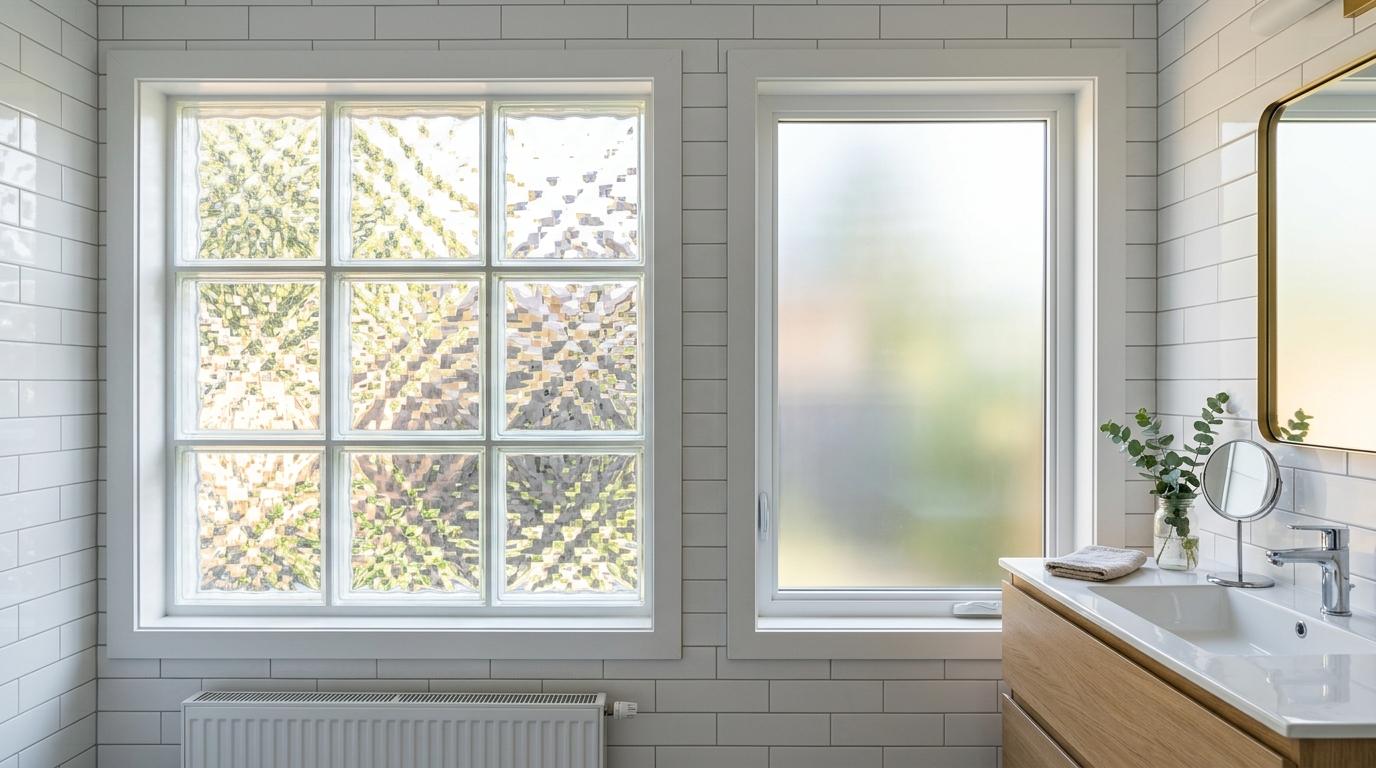
A homeowner in Meadow Vista called me last winter with a very specific problem. Her 1978 split-level had a small basement bathroom window sitting about 18 inches above grade, facing the side yard where a neighbor's new fence stopped two feet short of the property line. The old aluminum slider fogged in winter, leaked air, and offered zero real privacy. She wanted to know one thing: glass block or frosted glass?
That question comes up more than almost any other privacy glass question I get. Glass block vs frosted glass windows is not really a style debate — it is a functional decision about security, ventilation, insulation, installation cost, and where the window sits in the house. The right answer for a ground-floor bathroom is often the wrong answer for a daylight basement, and the right answer for a 1920s craftsman is often the wrong answer for a 2005 production home.
This guide compares both options head-to-head for the two rooms where privacy matters most: bathrooms and basements. You will get installed pricing, R-values, security ratings, code notes for California wet areas and egress requirements, and honest recommendations based on what we actually install in Sierra foothills homes.
TL;DR: Glass block windows cost $400–$900 installed, hit R-values of 1.75–2.0, and are the better pick for basements, ground-floor bathrooms near walkways, and security-sensitive openings. Frosted glass in a standard dual-pane IGU costs $150–$400 installed, opens for ventilation, hits R-values of 3.0–4.0, and wins for second-floor bathrooms, modern remodels, and any opening that needs egress. Neither works as an egress window without special planning.
Glass Block vs Frosted Glass Windows: Quick Comparison
Before digging into the details, here is how the two options stack up across the factors that actually drive the buying decision. Both meet California safety glazing rules when specified correctly. Both give you visual privacy. After that, they diverge quickly.
| Factor | Glass Block Window | Frosted Glass Window |
|---|---|---|
| Installed cost (standard bathroom size) | $400–$900 | $150–$400 (glass swap) / $500–$1,500 (full window) |
| R-value | 1.75–2.0 | 3.0–4.0 (dual-pane Low-E) |
| Light transmission | 60–75% (varies by pattern) | 70–85% |
| Operable / ventilates | No (or small vent block) | Yes |
| Security rating | High — hard to breach | Moderate |
| Typical lifespan | 40–60+ years | 20–30 years (IGU seal life) |
| Best for | Basements, ground-floor baths, laundry rooms | Second-floor baths, modern remodels, operable windows |
| Egress-capable | No (unless vented block panel system) | No (frosted alone does not meet egress) |
| Style era | Traditional, industrial, mid-century | Modern, contemporary, transitional |
What Is a Glass Block Window, Exactly?
Glass block is a masonry-style product. Each block is a hollow, pressure-sealed square of thick glass — typically 3-1/8 inches deep — that gets mortared or silicone-joined into a grid inside a window opening. The air trapped inside each block gives it real insulating value, and the thickness gives it real impact resistance. According to Pittsburgh Corning, the largest U.S. glass block manufacturer, a standard 8x8x4 block weighs roughly 6 pounds and tests at around R-1.96 (Pittsburgh Corning, 2024).
Glass blocks come in several patterns that change the privacy and light behavior. Wave, Icescapes, and Decora are the three most common patterns we install. Each scatters light differently — Decora looks like cracked ice and gives the highest privacy, while Wave has a flowing ribbed pattern that reads more decorative.
The tradeoff is that a traditional mortared glass block panel is a fixed, non-operable wall of glass. It does not open. It does not let air in. For bathrooms that rely on a window for ventilation instead of a fan, that is a deal-breaker. Manufacturers do make vented block units — a small hopper or awning vent integrated into one or two blocks in the panel — but availability and sizing options are limited, and the vent openings are small.
What Is a Frosted Glass Window?
Frosted glass is a standard window with one surface treated to obscure visibility. The treatment is usually acid-etching or sandblasting on one face of a tempered pane, and that pane gets sealed into an insulated glass unit (IGU) just like any other modern window. The result looks and functions like a normal vinyl or fiberglass window — it opens, locks, and performs thermally the same way clear glass does — but you cannot see through it.
This is the default privacy option for the majority of bathroom remodels we do. According to the National Kitchen and Bath Association's 2025 remodeling report, privacy glass options are specified in roughly 30 percent of new residential shower and bathroom window orders, with frosted leading the category by a wide margin (NKBA, 2025). The reasons are simple: it costs less than glass block, it opens for ventilation, and it matches the look of modern window frame materials like vinyl and fiberglass.
Frosted glass is also available in every window style — double-hung, casement, awning, slider, picture. That flexibility matters when you are matching a new bathroom window to the rest of the house. Glass block only comes as a fixed panel. A frosted casement matches the existing casements on the rest of the bedroom floor without looking like a basement retrofit.
Cost Comparison: Glass Block vs Frosted Glass Installed
Installed pricing for these two products is closer than most homeowners expect once you account for everything, but the breakdown tells different stories. Glass block has higher labor content — each block is hand-set in mortar or silicone, panel anchors have to be installed into the rough opening, and the job takes most of a day. Frosted glass windows are factory-built and installed like any other window, which keeps labor hours down.
Here is what we typically quote for a standard 32-by-24-inch bathroom or basement window opening in the foothills, based on materials and labor in the $65–$85/hr range common for our market.
Pro Tip: If your existing frame is in sound shape, a glass-only swap to frosted tempered IGU is almost always the cheapest route to privacy. We did one on a 1990s Auburn tract home last spring — $310 for a frosted swap that would have been $1,100 in new window, same privacy result. Glass block is the right call when the opening is a security concern or the frame is rotting and you want a maintenance-free solution for decades.
| Scope | Glass Block | Frosted Glass (Dual-Pane IGU) |
|---|---|---|
| Material — 32x24 panel | $220–$380 | $120–$240 |
| Labor — 4–8 hours | $260–$520 | $100–$250 |
| Full installed total | $480–$900 | $220–$490 (glass-only swap) |
| Full window replacement (frame + frosted glass) | N/A | $500–$1,500 |
| Vented block upgrade | +$150–$300 | Already included (operable) |
| Typical lead time | 1–2 weeks | 3–10 days |
Bathroom Privacy Windows: Which One Wins?
For most bathroom privacy windows, frosted glass is the right answer. For specific bathroom situations, glass block is the right answer. The dividing line is almost always location, ventilation, and security exposure — not aesthetics.
Frosted glass wins in bathrooms that need to ventilate without a mechanical fan, bathrooms on upper floors where security is not a concern, and bathrooms in modern or transitional home styles where masonry-style glass block would look out of place. It also wins anywhere you want to match the existing window style in the rest of the house. The frosted options in the full comparison of bathroom privacy glass options all integrate cleanly with operable vinyl, wood, or fiberglass frames.
Glass block wins in ground-floor bathrooms facing walkways or neighbors, bathrooms where the window sits low enough that someone could stand right next to it, and bathrooms in traditional or industrial style homes where the block look actually fits the design. It also wins where humidity and condensation have historically destroyed wood frames — block panels are effectively immune to rot, so a damp 1960s bathroom with a perpetually wet window wall is a great glass block candidate.
A client in Grass Valley had a small half-bath with a west-facing window three feet off a shared driveway. The old aluminum slider condensed heavily in winter, the frame was pitted, and any visitor in the driveway could see movement through the clear glass. We installed a 24x24 Decora-pattern block panel for $620 installed. Total privacy, R-1.96 where an aluminum slider had been leaking air for 50 years, and zero maintenance going forward. A frosted replacement would have been cheaper up front but would not have solved the frame-rot cycle or the security exposure from the driveway.
Basement Glass Block Installation: Why It Usually Wins Down There
For basement windows specifically, glass block is almost always the better pick, and this is where basement glass block installation has become the default in the industry. According to the U.S. Department of Energy's basement energy-efficiency guidance, basement windows are historically one of the largest air-leak paths in older homes and a common security weak point (DOE Energy Saver, 2025). Glass block addresses both problems in a single product.
There are four reasons basement glass block installation is the standard recommendation:
- **Security.** A basement window is often at or below grade, hidden from the street by landscaping or window wells. That makes it a preferred entry point for break-ins. Solid glass block is genuinely hard to breach — a burglar trying to crawl through has to break multiple blocks out of mortar, which is loud, slow, and visible. A frosted operable slider is a locked pane that pries open in seconds. - **Moisture and rot resistance.** Basement window openings sit in damp concrete or block walls and frequently have water intrusion issues from window wells. Wood or vinyl frames decay. Block panels sealed with mortar and silicone do not. - **Insulation.** Old basement windows are usually single-pane aluminum or steel — R-0.9 at best. Swapping to an R-1.96 block panel nearly doubles the insulating value of that opening and kills most of the air leakage at the same time. - **Longevity.** Glass block panels installed in 1970s basements are routinely still functional today. A vinyl-framed basement window with a sealed IGU has a 20–30 year service life before the seal fails and fogs.
The exception to the basement-block rule is when the basement has a finished bedroom, a home office, or any sleeping room. Those rooms trigger California egress requirements, and a fixed block panel does not meet egress. For those, you need either a properly sized operable window or a specific vented-block egress system — see the code section below.
Privacy and Light: How They Actually Compare
Both glass block and frosted glass give you visual privacy. They get you there differently, and the nighttime performance is where they diverge most. This is the comparison homeowners care about but almost never see quantified.
Frosted glass relies on a uniform etched surface to scatter light. During the day, it blocks about 95 percent of visibility while transmitting 70 to 85 percent of available light. At night, with interior lights on and dark outside, a well-specified frosted pane still blocks clear shapes — you might see a soft glow of interior light and occasional silhouettes against the pane, but no identifying detail.
Glass block relies on thickness, internal air chambers, and a molded pattern to distort vision. Straight-on privacy is excellent during both day and night. The pattern matters, though. Wave pattern transmits more light and distorts less — you might see moving color or silhouette from close range. Decora and Icescapes are much more aggressive, breaking up any straight-line view into geometric chaos that reads as completely opaque.
Here is a quick rule of thumb for choosing between them based on how close the viewer is:
1. **Viewer more than 15 feet away (upper-floor window, second-story bath).** Either option is fully private. Pick on cost and aesthetics. 2. **Viewer 5–15 feet away (ground-floor bath, neighbor's window across yard).** Frosted is fine day and night; block is fine day and night. Both work. 3. **Viewer 1–5 feet away (ground-floor bath near walkway, basement near driveway).** Glass block with Decora or Icescapes pattern is the safer pick. Frosted still blocks detail but can reveal silhouette at night from close range. 4. **Viewer touching the window (ground-level basement with grade-level walkway).** Glass block only. Period.
One more detail on light: glass block throws a distinctive patterned light into the room during the day. Some people love it — it gives a bathroom character and a vintage feel. Some people find it dated. Frosted glass throws uniform, diffuse light that reads more modern and neutral. This is a genuine style call, not just a privacy call.
Security Comparison: Which Is Harder to Break Through?
Security is the single biggest reason homeowners choose glass block over frosted glass, and the difference is larger than most people realize. A standard tempered dual-pane IGU is strong against impact — it will not shatter into sharp shards when struck — but it can be defeated by a determined pry attack at the sash or frame. A glass block panel, on the other hand, requires breaking multiple blocks out of a mortar grid before a person can fit through.
According to FBI Uniform Crime Reporting data, unforced entry through ground-floor and basement windows remains one of the top three entry methods in residential burglaries nationwide (FBI UCR, 2024). Rural and semi-rural homes at Sierra foothill elevations are not immune — Placer and Nevada counties both saw measurable residential burglary volume in the most recent reporting cycle, and basement and ground-floor windows are common points of forced entry in those cases.
For a ground-floor bathroom along a sidewalk or a basement window sitting below grade in a window well, glass block adds a real physical barrier that a locked operable window does not. This is the same reason laundromats, small retail storefronts, and older industrial buildings still specify glass block panels for ground-floor openings. It is not decorative — it is functional deterrence. If you want the security layer without committing fully to block, another option is to pair frosted glass with security window film, which adds a polyester barrier that resists pry and smash attacks on a standard frosted window.
Insulation and Energy Performance
Glass block is often assumed to be a thermal winner because of the thickness. It is not. The air inside a block is not a true vacuum or low-conductivity gas fill, and the mortar joints between blocks are thermal bridges that leak heat. According to Whole Building Design Guide data on masonry glazing, a standard glass block panel tests at R-1.75 to R-2.0 overall including mortar joints (WBDG, 2024). That is better than single-pane glass, but it is significantly worse than a modern dual-pane Low-E IGU.
A dual-pane Low-E frosted window in a vinyl or fiberglass frame typically delivers R-3.0 to R-4.0 depending on gas fill and coating stack. A triple-pane unit can push past R-5.0. That means for pure thermal performance, frosted glass in a modern IGU roughly doubles the insulating value of glass block.
So why does glass block ever win on energy? Two reasons. First, it is replacing something far worse — usually a single-pane aluminum basement window at R-0.9 that leaks air heavily. Going from R-0.9 to R-1.96 is a near-doubling of thermal resistance even if it is not as good as R-3.5. Second, glass block panels are virtually airtight when properly mortared and silicone-sealed. A poorly installed vinyl window can leak air around the frame even if the IGU itself is R-3.5. At the Colfax elevation of roughly 2,400 feet, where we see regular freeze-thaw cycles and sustained winter lows, reducing air infiltration matters as much as raw R-value.
If thermal performance is your top priority and the window is on a conditioned wall, frosted glass in a dual-pane Low-E IGU is the winner. If thermal performance matters but you are also weighing security, longevity, and air-sealing on a previously leaky basement opening, glass block's lower R-value is usually still an upgrade overall.
California Code: Safety Glazing and Egress Rules
Both products have to clear the same two California Building Code hurdles: safety glazing in wet areas and egress sizing in sleeping rooms. Miss either one and the inspector will fail the install.
**Safety glazing (CBC Section 2406):** Any glazing within 60 inches of a water source in a bathroom has to be safety glass — tempered or laminated. For frosted glass, that means specifying a tempered frosted IGU, which is standard and stocked. For glass block, the blocks themselves are not tempered, but Section 2406.4 specifically exempts structural glass block panels from the tempered requirement when installed per manufacturer specs. The panel is considered its own code-approved assembly. Both products pass, but the compliance path is different. This is also relevant anywhere you are combining privacy glass with tempered or laminated shower glass.
**Egress (CBC Section 1030):** Every sleeping room needs at least one window or door that meets egress — a minimum 5.7 square foot openable area (5.0 for ground-floor), minimum 24-inch clear opening height, minimum 20-inch clear opening width, and a sill no higher than 44 inches above the floor. A fixed glass block panel does not open, so it does not meet egress on its own. A standard frosted casement or awning can meet egress if sized correctly. If the basement bathroom is part of a finished basement that includes a bedroom, family room, or other habitable space with a sleeping function, the egress rule applies and glass block is not a standalone solution. There are specialty vented-block systems that integrate a hinged egress panel into the block grid, but they are specialty orders — expect a 3-to-5-week lead time and 30-to-50 percent cost premium over a standard block panel.
**Glazing near exits and stairs:** Section 2406.4 also requires safety glazing for any glass within 24 inches of a door or 36 inches above a walking surface on a stairway landing. If your basement window sits near the basement stairs, factor this in. Both tempered frosted and glass block panels clear this requirement.
Installation: What Each One Actually Looks Like
The installation experience for these two products is very different. Understanding what happens on install day helps set expectations and avoid surprises.
**Glass block installation (half to full day):**
1. Remove the existing window sash, frame, and any interior/exterior trim down to the rough opening. 2. Inspect and repair the opening — block, stud, or masonry as appropriate. Flash and waterproof as needed. 3. Set the base course of blocks in mortar or panel-mount silicone, using plastic spacers to maintain uniform joints. 4. Build up the panel course by course, tooling joints as you go. Anchor the panel to the opening with wall ties or expansion anchors. 5. Finish the perimeter with mortar or high-grade silicone caulk and trim to match the interior. 6. Cure time is 24–48 hours before the panel is fully structural. Minor mortar dust cleanup is the norm.
**Frosted glass installation (2–4 hours for glass swap, 4–6 hours for full window):**
1. If a glass-only swap: remove the sash stops or glazing beads, pop the existing IGU, inspect the frame, and set the new frosted tempered IGU in fresh bed glazing. Replace stops/beads and clean up. Done. 2. If a full window replacement: remove the old window, prepare the opening, install the new pre-built frosted window per retrofit or full-frame methods, flash and seal, reinstall trim, and clean up. 3. Minimal dust, same-day completion, window is fully operable immediately.
The glass block install is more disruptive but results in a permanent, maintenance-free panel. The frosted install is less disruptive and preserves the option to swap the glass again in 20 years if tastes change. Both are straightforward for an experienced glazier. Neither is a DIY job if you value a clean result and code-compliant flashing.
When to Pick Each One: Quick Decision Matrix
Here is the cheat sheet version of the decision. Run through these questions in order and the answer usually becomes obvious by question three or four.
- Is this a sleeping room? If yes, you need egress — default to frosted in a properly sized operable window.
- Is this a basement, ground-floor utility, or security-exposed opening? If yes, strongly consider glass block.
- Does the room need to ventilate through this window? If yes, frosted in an operable sash.
- Is the window well above eye level on an upper floor? If yes, frosted is cheaper and cleaner.
- Does the home's style lean traditional, industrial, or mid-century? Glass block fits better aesthetically.
- Does the home's style lean modern, contemporary, or transitional? Frosted fits better aesthetically.
- Is the existing frame rotted or leaking? Glass block eliminates future frame issues entirely.
- Is the budget tight and the existing frame sound? A frosted glass-only swap is the cheapest path to privacy.
Common Mistakes to Avoid on Privacy Window Projects
After installing both products across the foothills for years, a handful of errors keep repeating. Most of them cost homeowners money or force a redo within five years.
- **Specifying glass block for a bedroom egress window.** The inspector will fail it. You need either a properly sized operable window or a specialty vented-block egress unit — not a standard panel. - **Assuming glass block is airtight out of the box.** A poorly mortared panel leaks air around every joint. Hire someone who has built block panels before or accept that a cheap install will perform worse than a standard vinyl window. - **Picking a Wave pattern for a ground-floor window near a walkway.** Wave blocks transmit more visible light and detail than Decora or Icescapes. If privacy is the whole point, pick the more aggressive pattern. - **Swapping to frosted glass without addressing a rotting wood frame.** You just bought new privacy glass and left the real problem untouched. If the frame is compromised, do a full window replacement or switch to glass block and solve the frame issue permanently. - **Forgetting about nighttime privacy.** Both products work during the day. At night, with interior lights on, cheaper frosted films and lighter glass block patterns can reveal silhouette from close range. Test with a flashlight before you commit. - **Skipping tempered specification on the frosted IGU.** A non-tempered frosted pane within 60 inches of a bathroom water source is a code violation and a safety hazard. Always confirm tempered on the order.
What We Actually Recommend in Sierra Foothills Homes
Across the homes we work on in Colfax, Auburn, Grass Valley, Nevada City, Foresthill, and the smaller foothill communities, the split breaks down roughly like this. For second-floor bathrooms, upper-level powder rooms, and any modern remodel bathroom where a matching operable window is on the order, we install frosted dual-pane Low-E — almost every time. For ground-floor bathrooms facing walkways, basement bathrooms, basement utility windows, laundry rooms with exterior walls, and older homes where the existing frame is in rough shape, we install glass block — also almost every time.
The climate here rewards both choices for different reasons. Foothill winters put freeze-thaw stress on window frames and seals. Glass block panels sealed with mortar and silicone shrug that off. Frosted glass in a quality vinyl or fiberglass frame handles it fine too, but the IGU seal has a finite life and will eventually fog — especially if elevation and temperature swings accelerate double-pane seal failure the way they do above 2,000 feet.
One last note: whichever you choose, make sure the installer pulls permits where required and flashes the rough opening correctly. A privacy window that leaks water into a wall cavity is a bigger problem than any privacy issue you started with. If you are weighing this decision for a specific project, a site visit from a qualified glazier is worth more than any online comparison — we can look at the opening, the exposure, the frame condition, and the surrounding style and give you a straight answer in 20 minutes.
If you are in Colfax, Auburn, Grass Valley, or the surrounding foothill communities and want to talk through a privacy window project, our team at Colfax Glass installs both products regularly and can walk the opening with you before you spend a dollar.