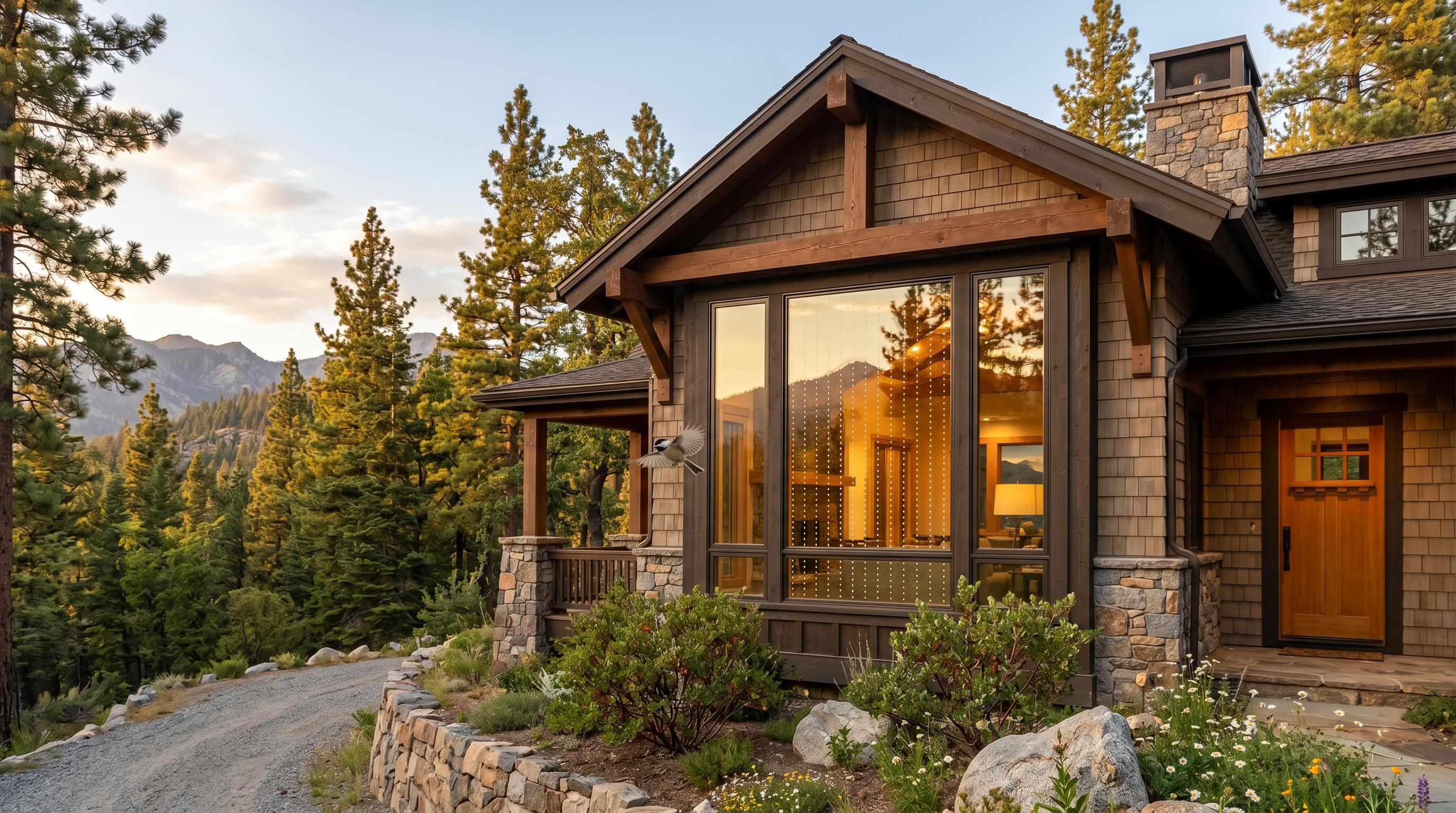
A Foresthill homeowner called me last spring. She'd just finished a beautiful great-room remodel — three big picture windows facing a slope of black oak and ponderosa pine, full canyon view, the kind of glass wall that makes Sierra foothill homes special. Two months in, she'd already buried four birds: a Townsend's warbler, two cedar waxwings, and a pygmy nuthatch. Her grandkids had started naming them. She didn't want art glass or curtains. She wanted to keep the view and stop killing birds.
That conversation is happening more often. The Sierra foothills sit directly under the Pacific Flyway, the migratory corridor used by roughly 1 billion birds moving between Alaska and South America every year (Audubon, 2024). Add Colfax's elevation transition — oak woodland flowing into mixed conifer at 2,400 feet — and you get unusually high bird density right where homeowners want unobstructed glass.
I'm John, owner of Colfax Glass. Over the past three years we've installed or retrofitted bird-safe glass on more than forty homes across Placer County, Nevada County, and El Dorado County. This guide covers what bird-safe glass actually is, how the threat factor system works, what 2026 California code is doing to push the market, and what realistic retrofits cost on a foothill home. No greenwashing. Just what the testing data and the field experience show.
TL;DR: Glass kills up to 1 billion birds per year in the U.S. (American Bird Conservancy, 2024). Foothill homes on the Pacific Flyway face elevated risk because of reflected vegetation and migration density. Bird-safe glass uses patterns spaced 2 inches apart (vertical) or 4 inches by 2 inches (grid) to break up reflections. Effective retrofits — Feather Friendly dots, acid-etched patterns, or UV-reflective films — run $4 to $24 per square foot installed. California's 2026 code cycle is moving toward San Francisco Standard 139 and AB 262 procurement rules; expect coverage to expand statewide.
Why Foothill Homes Sit at the Center of California's Bird Collision Problem
Three things make Sierra foothill homes disproportionately dangerous to birds. The Pacific Flyway funnels millions of migrants through the corridor between the Sacramento Valley floor and the Sierra crest each spring and fall. The vegetation transition between oak woodland and conifer happens right at our elevation, which concentrates resident species like spotted towhees, white-breasted nuthatches, and Northern flickers in the same yards where homeowners build view-oriented great rooms. And the homes themselves tend to maximize south- and west-facing glass to capture mountain views — the exact orientations that create the most reflective hazards.
The American Bird Conservancy's research, summarized by Cornell Lab of Ornithology (2024), pegs total U.S. bird mortality from glass collisions at 365 million to 988 million annually. Roughly half of those deaths happen at residential windows, not commercial high-rises. A single home with reflective view windows in a high-quality habitat can kill more birds in a year than a downtown office tower.
The physics is simple. Birds don't perceive glass as a barrier. What they see is a reflection of trees, sky, or open space, or a clear path through to vegetation on the other side of a building (the "see-through" effect when two windows align). The brain reads it as flight space. By the time visual cues say otherwise, the bird is hitting the glass at 20 to 30 mph. Most strikes are fatal or cause internal injuries that kill the bird within hours, even if it flies away.
I had a customer in Iowa Hill build a stunning all-glass corner in his living room — two ten-foot picture windows meeting at 90 degrees, no mullion, no break. Beautiful detail. Within a month it had killed nine birds. The pass-through illusion was so complete that even chickadees weren't reading it as a barrier. We retrofitted the corner with vertical Feather Friendly dots two inches apart. Strike count in the next twelve months: zero.
- Reflection strikes — sky, clouds, and trees mirrored on the exterior pane (most common in foothill homes)
- Pass-through strikes — bird sees vegetation through aligned windows or glass corners and tries to fly through
- Lit-window strikes — interior light at dawn or dusk attracts insects and the birds hunting them
- Territorial strikes — male birds attacking their own reflection during breeding season (March to June)
- Migration strikes — disorientation around lit windows during nighttime migration (peak: April–May, September–October)
What Counts as Bird-Safe Glass? The 2x4 Rule and Threat Factor Scoring
Bird-safe glass isn't a brand or a single product category — it's any glazing assembly that meets the visual deterrence standards birds can actually perceive. The American Bird Conservancy (ABC) has been the central authority on this since 2010, and the testing protocol they developed (the tunnel test) is the basis for most current code references.
The core design rule is called the 2 by 4 rule. Markers — dots, lines, stripes, frit patterns, etched textures, or applied films — must be spaced no more than 2 inches apart vertically OR 4 inches apart horizontally. Most species, including small songbirds, will avoid any opening smaller than that. Some sources tighten this to 2 by 2 inches for high-risk environments like foothill view homes, where Anna's hummingbirds (which can squeeze through a 2-inch gap) make up a measurable share of the kill list.
Markers should be at least 1/8 inch in diameter or 1/8 inch thick. They need adequate visual contrast — light patterns on dark backgrounds, dark on light, or UV-reflective patterns that birds see but humans largely don't. Critically, the markers must be on the exterior surface (Surface 1) of the glass. Patterns applied to interior surfaces lose effectiveness because the reflection layer happens between the bird and the marker.
ABC scores products using a Threat Factor scale from 0 to 100. Lower is better. A threat factor of 30 or below qualifies as bird-friendly under most U.S. and Canadian standards (San Francisco Standard 139, USGBC LEED Pilot Credit 55, Toronto Bird-Friendly Guidelines). A threat factor below 15 is considered highly effective. Untreated clear glass scores 100. Mirrored or highly reflective glass can effectively score above 100 in some real-world conditions because of false-positive reflections.
| Threat Factor | Performance Tier | Use Case | Example Products |
|---|---|---|---|
| 0–15 | Excellent | High-risk facades, view homes, public buildings | Walker Textures Aviprotek, Ornilux Mikado |
| 16–30 | Bird-friendly (qualifies for SF Std 139) | Standard residential retrofits, new construction | Feather Friendly dots, Solyx BF films, Guardian AviProtek E |
| 31–50 | Moderate | Lower-priority facades, indoor partitions | UV-only patterns at 4x4 spacing, light fritting |
| 51–100 | Not bird-friendly | — | Untreated clear glass, mirrored glass, low-E without pattern |
The Pacific Flyway and Sierra Foothill Bird Species at Highest Risk
The Pacific Flyway is one of four major North American migration corridors. It runs from the Arctic tundra down through British Columbia, Washington, Oregon, California, and into Mexico, Central America, and South America. Roughly 350 bird species use it. The eastern edge of the flyway hugs the Sierra Nevada — meaning Colfax, Auburn, Grass Valley, and the foothill belt sit in a high-density bird corridor for both migrants and year-round residents.
The species at greatest collision risk on Sierra foothill homes fall into three groups. Resident songbirds — chickadees, nuthatches, towhees, juncos, scrub-jays — are the dominant year-round victims. They learn the territory but never learn the glass. Migrants moving through in spring and fall add seasonal spikes; warblers, thrushes, and tanagers hit windows during peak passage in late April to mid-May and again in September to mid-October. And the foothill specialists — pileated woodpeckers, Steller's jays, mountain quail — get killed less often but more visibly, because their bodies don't disappear into the leaf litter.
Larger raptors face a different kind of glass risk. Golden eagles and red-tailed hawks rarely strike residential windows directly, but they do take prey near homes and occasionally chase a songbird straight into a window during a hunt. The California spotted owl, a federally listed species under the Endangered Species Act, has been documented colliding with mountain cabins built inside its old-growth conifer territory. Reducing residential collisions in spotted owl habitat (much of the Tahoe National Forest interface around Foresthill and Iowa Hill) has direct conservation value.
If you live above 1,500 feet in oak woodland or mixed conifer and have south- or west-facing windows larger than 8 square feet, assume your house is in the high-risk category. Cornell's bird collision tracking found that homes with these three traits killed roughly 4 to 8 birds per window per year on average — and that's only the carcasses people find. Scavenger removal (ravens, foxes, neighborhood cats) means the real number is higher.
- Anna's hummingbird — high local density year-round, small enough to slip through 2-inch gaps
- Cedar waxwing — flock species, multiple birds can hit the same window in a single event
- Townsend's warbler — Pacific Flyway migrant, peak risk April–May and September–October
- Hermit thrush — ground feeder, low-flying, especially vulnerable to ground-floor windows near brush
- Pygmy nuthatch — ponderosa pine specialist, common around Colfax and Foresthill yards
- Steller's jay — year-round resident, larger body mass increases mortality even in glancing strikes
- Northern flicker — may also drum on metal flashing or chimney caps; reflective glass adds collision risk
- California spotted owl (federally protected) — old-growth conifer habitat, foothill/montane edge homes
Bird-Safe Glass Treatment Options: What Actually Works in the Foothills
There's no single right answer. The best treatment depends on whether you're retrofitting an existing window or specifying glass for a new build, how much you can spend, and how much pattern visibility you can tolerate. The five categories below cover everything I install. I've ranked them by ABC threat factor performance and real-world durability in our climate (UV-intense summers, freeze-thaw winters above 2,500 feet).
Applied dot patterns (Feather Friendly) are the workhorse residential retrofit. These are pre-spaced 1/4-inch white or charcoal dots on a clear acetate carrier sheet. You apply them to the exterior glass surface like a giant decal, peel off the carrier, and the dots remain. Visible from inside but largely disappear from a few feet away. Threat factor: 18–24 depending on spacing. Durability in the foothills: 8 to 12 years before UV degradation makes reapplication worthwhile.
Acid-etched and ceramic frit patterns are the gold standard for new construction or full glass replacement. The pattern is fired into the glass surface during manufacturing, so it can't peel, fade, or be cleaned off. Threat factor: 5–18 depending on density. Cost premium over standard insulating glass: roughly 25 to 60 percent. Brands like Walker Glass (Aviprotek), Vitro (Solarban with frit), and Guardian (AviProtek E) all make commercially available residential lines now.
UV-reflective coatings (Ornilux, some specialty films) use a pattern visible to birds — whose vision extends into the ultraviolet — but mostly invisible to humans. Threat factor on the highest performing products like Ornilux Mikado: under 15. Major caveat: UV-only solutions only work on Surface 1 (exterior) and only on certain glass substrates. They lose substantial effectiveness on tinted or strongly reflective glass because the human-visible reflection drowns out the UV signal birds need to see. For most foothill view homes with Low-E coatings, UV-only solutions underperform.
Exterior screens (the kind sold for sliding doors, mounted permanently on the outside surface) are the single most effective option. Threat factor: under 5. They block reflections completely and provide a physical visual barrier. The trade-off is aesthetic — they read as commercial. Most homeowners use them on a few high-collision windows rather than the whole house.
DIY tape, cling decals, and dot kits work if applied at proper spacing and on the exterior surface. The most common mistake I see: a single decorative hawk silhouette on a window. Those don't work. Birds need to see a regular, repeating pattern across the entire glass area, not a single shape. Acopian BirdSavers (paracord curtains) are an aesthetic-friendly DIY alternative that performs well — threat factor under 20 when properly installed.
| Treatment | Threat Factor | Cost Installed | Lifespan | Best Use |
|---|---|---|---|---|
| Feather Friendly dots | 18–24 | $4–$8 per sq ft | 8–12 years | Retrofit existing windows, fast turnaround |
| Acid-etched / frit glass (full IGU) | 5–18 | $45–$90 per sq ft | 30+ years | New construction, full window replacement |
| Solyx BF or 3M bird-safe film | 20–28 | $8–$14 per sq ft | 10–15 years | Mid-range retrofit, also adds UV/solar control |
| Ornilux UV-reflective glass | 10–25 (substrate dependent) | $60–$110 per sq ft | 30+ years | New construction where pattern visibility unwanted |
| Exterior insect screens | <5 | $15–$24 per sq ft | 10–20 years | Highest-risk windows, lake/canyon view homes |
| Acopian BirdSavers (paracord) | 15–20 | $2–$4 per sq ft (DIY) | 5–10 years | Budget retrofit, rural homes, rental properties |
| Decorative hawk silhouette (single decal) | 85–100 | — | — | Does not work — avoid |
California's 2026 Building Code Trends: AB 262, Standard 139, and What's Coming
California has been the national leader on bird-safe building policy, but coverage has been uneven. As of early 2026, here's the actual regulatory landscape and where it's heading. This affects new builds, major remodels, and — increasingly — public projects funded with state dollars.
San Francisco Standards for Bird-Safe Buildings (Std 139) is the foundational California ordinance. Adopted in 2011 and updated in 2020, Std 139 applies to new construction within the City and County of San Francisco. It requires bird-safe glazing on the lower 60 feet of buildings (the "bird collision zone") in defined hazard areas, including buildings adjacent to or facing open space, water, or significant vegetation. The standard is technical: maximum threat factor of 30, applied to all unbroken glass surfaces over 24 inches in any direction. While Std 139 is municipal, it has become the de facto reference standard for any California jurisdiction adopting bird-safe rules.
AB 262 (the Bird-Safe Buildings Act) is the most significant statewide development. Originally introduced in 2019 and reintroduced in subsequent sessions, AB 262 — when fully enacted — applies to new state-funded construction projects, requiring bird-friendly glass and lighting controls on government buildings. As of 2026, AB 262 has moved through multiple iterations, with the current procurement-focused version most likely to advance. For private foothill homeowners, AB 262 doesn't directly apply, but the procurement effect ripples into the supply chain: glass manufacturers expand bird-safe product lines, distributors stock them, and pricing comes down for everyone.
Local jurisdictions are moving faster than the state. Oakland, Berkeley, Mountain View, and San Jose have all adopted some form of bird-safe glazing requirement on new commercial and multifamily construction. Sacramento County and Placer County have not yet adopted bird-safe ordinances as of the 2026 code cycle, but Placer County's 2026 Title 24 update does include voluntary bird-safe options in its sustainable design checklist for permitted projects. Foothill municipalities should be expected to follow within 3 to 5 years based on the trajectory of similar building safety adoptions.
LEED Pilot Credit 55 (Bird Collision Deterrence) gives projects pursuing LEED certification one credit point for meeting the bird-safe glazing threshold. For homeowners building to LEED standards (still rare in residential, more common in luxury foothill builds aiming for green certification), the credit is straightforward to achieve with frit or applied dot products. The U.S. Green Building Council also maintains the WELL Building Standard, which includes a similar requirement.
At the federal level, the Federal Bird-Safe Buildings Act has been introduced in multiple Congresses but has not become law as of early 2026. The bill would require bird-safe design in new federal building construction. Whether or not it passes, the GSA's Public Buildings Service has independently begun specifying bird-safe glazing in federal building projects under sustainable design guidelines.
What this means for foothill homeowners: you're not legally required to install bird-safe glass on a custom Colfax or Auburn home in 2026 — but the cost premium is shrinking fast as the broader California market scales up. Frit glass that cost a 75 percent premium five years ago now runs 25 to 40 percent over standard IGU pricing. If you're doing a full-frame replacement or a new build with view glazing, specifying bird-safe options now is significantly cheaper than retrofitting in three years.
Real Costs to Make Your Foothill Home Bird-Safe
Pricing depends entirely on whether you're retrofitting or replacing. Below are the numbers I quote on actual foothill jobs in 2026, based on Colfax Glass project records from Placer, Nevada, and El Dorado counties. They include labor and materials but not pre-existing window damage repairs, scaffolding for windows above 12 feet, or HOA approval delays in subdivision communities.
For retrofits on existing windows, Feather Friendly dots are the cost leader at $4 to $8 per square foot installed. A typical Sierra foothill home with three picture windows totaling 80 square feet of glass runs $320 to $640 for the highest-risk facade. That's the package I quote most often when a customer wants a fast, reversible solution that doesn't change the look from inside.
For mid-range retrofits, Solyx bird-safe films and similar products run $8 to $14 per square foot installed. Films add the benefit of solar heat rejection — useful on west-facing foothill walls where summer heat gain is a real cost driver. They're a reasonable choice when you're already considering solar control window film for performance reasons; bird-safe versions add the visual pattern at modest additional cost.
For new construction or full IGU replacement, ceramic frit glass adds 25 to 60 percent over standard insulating glass costs. On a typical foothill replacement window package — say, 12 windows at $700 to $1,200 each in standard configuration — adding frit on the highest-risk units (usually 4 to 6 windows) adds $1,400 to $4,300 to the project total. For a full bird-safe glass package across an entire view facade, expect to add $5,000 to $14,000 to a 12-window replacement.
Ornilux and other UV-only premium products run $60 to $110 per square foot installed. They're the most expensive option and only make sense in two scenarios: high-end custom builds where pattern visibility is unacceptable, or institutional projects with bird-safe code requirements and aesthetic constraints. For most foothill homeowners, ceramic frit or applied dots deliver better performance per dollar.
Acopian BirdSavers paracord systems are the cheapest effective option — $2 to $4 per square foot if you DIY, $6 to $10 per square foot if professionally installed. They look like vertical drapery from outside, which some homeowners love and others can't stand. They work especially well on architectural styles where vertical line elements already feature in the design.
Pro tip: not every window needs treatment. The 80/20 rule applies — typically 20 percent of a home's windows account for 80 percent of bird strikes. Walk your property after a strike season (spring or fall) and identify which windows have been responsible. Treat those first. On most foothill homes, that's two to four picture windows facing the dominant view direction, plus any glass corner or alignment that creates a pass-through illusion.
- Single high-risk window (40 sq ft picture window) retrofit with Feather Friendly: $160–$320
- Whole-facade retrofit on a foothill view home (200 sq ft glass): $800–$1,600 with dots; $1,600–$2,800 with films
- New construction frit upgrade on 6 view windows (~150 sq ft glass): $2,000–$5,400 added cost
- Full bird-safe IGU package on 12-window replacement: add $5,000–$14,000 to standard replacement quote
- Ornilux specification on 8 view windows (200 sq ft): $12,000–$22,000 added cost vs standard IGU
- DIY Acopian BirdSavers (200 sq ft of glass coverage): $400–$800 in materials, weekend install
Foothill-Specific Installation Realities (Wind, UV, Freeze-Thaw)
Sierra foothill conditions are harder on bird-safe products than coastal or valley environments. Three factors matter most. UV intensity at elevation degrades adhesives faster than at sea level — Colfax at 2,400 feet receives roughly 12 to 18 percent more UV than Sacramento at 30 feet. Freeze-thaw cycling stresses the bond between any applied product and the glass; we get 30 to 50 freeze-thaw cycles per winter at the higher elevations. And canyon wind events stress exterior screens and paracord systems beyond what their flatland test data suggests.
For Feather Friendly and similar applied dot products, plan on 8 to 12 years of effective life in the foothills versus 12 to 20 years in milder climates. Adhesive failure shows up first at panel edges and corners. Annual inspection in late spring (after the freeze-thaw period ends) catches developing issues before whole sections lift.
For films, look for products specifically rated for exterior application with high-elevation UV durability. The 3M Prestige line and Solyx BF series both perform reasonably at our elevation. Avoid budget films from generic suppliers — interior-grade film applied externally typically degrades within 3 to 5 years here.
For frit and acid-etched glass, durability isn't a concern — the pattern is part of the glass. The installation concern is sourcing. Lead times on bird-safe IGU orders run 6 to 14 weeks from West Coast manufacturers, sometimes longer if you specify a custom pattern density. Plan accordingly when scheduling new construction or full-frame replacements.
For exterior screens, our wind environment matters. The Iowa Hill, Foresthill, and Gold Run corridors get sustained westerly canyon winds that can reach 40 to 60 mph during winter Pacific storms. Screen frames need to be rated for those wind loads, with proper anchoring into the window frame. I've seen budget exterior screens torn off in single storm events — a $400 retrofit becomes a $1,200 retrofit when the wind takes it down.
Combining Bird-Safe Glass with Other Foothill Glass Priorities
Most of my foothill customers aren't choosing bird-safe glass in isolation — they're integrating it into a larger window strategy that already has to handle wildfire defense, energy code, and view preservation. The good news: bird-safe options layer well with most other priorities.
Bird-safe + WUI (wildfire) glass: California's Chapter 7A WUI requirements mandate dual-pane tempered glass on the exterior pane in designated wildfire zones, which now includes most of Placer County's foothill belt. Both Walker Glass and Vitro offer bird-safe frit on tempered substrates that also meet WUI ratings. Pricing premium stacks but isn't double — typically 10 to 25 percent over WUI-compliant glass without the bird-safe pattern.
Bird-safe + Title 24 energy: California's 2026 Title 24 update tightened U-factor requirements to 0.30 (0.27 in Climate Zone 11, which covers Colfax). Frit and applied dot patterns don't materially affect U-factor or SHGC performance. UV-reflective coatings can interact with Low-E systems — verify the specific glass package with the manufacturer before specifying.
Bird-safe + view preservation: This is the conversation I have most often. Customers worry that any pattern will ruin the view. In practice, dots at 2-inch spacing read as a faint texture from inside and largely disappear from outside the glass. Vertical paracord curtains are the most visible option but read as architectural rather than industrial. Frit patterns can be specified at lower densities for view-prioritized installations — Walker's lighter Aviprotek patterns achieve threat factors in the 25 to 30 range while remaining nearly invisible from typical viewing distances of 6 feet or more.
Bird-safe + sound reduction: For homeowners on noisy roads (I-80 corridor through Colfax, Highway 49 through Auburn), laminated glass is often part of the sound-reduction package. Bird-safe frit applies to laminated glass without compromise. Pattern density and spacing logic stays the same.
On a 2025 project in Auburn, we did a full-house glass upgrade that hit four priorities at once: WUI Chapter 7A compliance (tempered exterior pane), Title 24 Climate Zone 11 (U-factor 0.27), I-80 sound reduction (laminated interior pane), and bird-safe (Walker Aviprotek light frit on Surface 1). Total package cost about 38 percent more than baseline replacement glass, but the homeowner solved every glass-related concern in one project. Doing those upgrades sequentially over five years would have cost roughly 60 percent more in total.
What to Do If Your Home Is Already Killing Birds
If you're finding dead birds at your windows, you don't need to wait for a quote to start preventing more strikes. Start with the temporary fixes below today, then plan a permanent treatment within the next 30 to 60 days. Most bird-strike prevention research, including from Cornell Lab of Ornithology (2024), shows that even crude temporary measures cut strike rates by 60 to 90 percent.
- Identify the highest-strike windows by walking the perimeter. Look for body smudges (oil, feathers stuck to glass), feathers on the ground beneath windows, and obvious carcasses
- For immediate prevention: apply painter's tape in a 2-inch grid pattern on the exterior surface of the worst windows. Ugly but it works while you wait for a permanent solution
- Move bird feeders and birdbaths to either within 3 feet of the window (so birds can't build up speed) OR more than 30 feet away (so they don't pass close to glass). The middle distance is the deadliest
- Close blinds and curtains during daylight hours on the windows you can't see-through. The interior darkness reduces reflection
- At night, turn off interior lights near windows during peak migration (April–May, September–October). Lit windows attract migrating birds at night
- Order a Feather Friendly residential kit ($30–$120 from feather-friendly.com or Amazon) for DIY application within 30 days
- If a bird hits your window and survives the impact, place it in a covered cardboard box in a quiet, warm location for 1 to 2 hours. Most concussed birds either recover and can be released or die of internal injuries within that window. Do not give food or water
- Track strikes for one full year — date, species if identifiable, window, weather conditions. The data tells you which windows actually need permanent treatment
Verifying Product Performance: How to Read ABC Ratings and Avoid Greenwashing
The bird-safe glass market has expanded fast, and not every product marketed as bird-safe actually meets the science. Three things to verify before specifying any product.
Look for the actual ABC threat factor number, not just the words "bird-safe" or "bird-friendly" on the marketing material. Reputable manufacturers (Walker Glass, Vitro, Guardian, Ornilux, 3M, Feather Friendly, Solyx) publish their threat factor data from ABC tunnel testing on product spec sheets. If a salesperson can't produce a threat factor, the product hasn't been independently tested.
Verify the spacing and visibility specifications. The 2 by 4 rule is the minimum standard. Marketing photos showing widely spaced bird-safe patterns (4 by 4 inches or wider) are a red flag — those patterns will let smaller songbirds and hummingbirds through. Demand pattern density specs in the data sheet.
Confirm Surface 1 application for any patterned product. A frit pattern on Surface 2 (the inside face of the exterior pane in a dual-pane assembly) loses 40 to 60 percent of its effectiveness because birds see the reflection of sky and trees on Surface 1 before they see the pattern. Some glass manufacturers default to Surface 2 for aesthetic reasons; you have to specifically request Surface 1.
For films and applied products, check installation surface in the warranty documentation. Some films are rated only for interior application — applying them externally voids the warranty AND degrades bird-safe performance. Solyx BF, 3M's exterior-rated lines, and Feather Friendly are explicitly Surface 1 / exterior products.
Finally, beware of the "hawk silhouette" decal. These are still sold widely and remain one of the most common bird-safe purchases by homeowners. They don't work. A single shape on a window doesn't break up the reflection across the rest of the glass. Birds simply fly into the untreated 95 percent of the window. The American Bird Conservancy has explicitly cautioned against hawk silhouettes since at least 2014.
Hiring a Glass Contractor Who Understands Bird-Safe Specs
Most California glass shops can install standard residential glass and window packages. Far fewer have hands-on experience with bird-safe glass specifications, which is a problem because the difference between a competent and incompetent installation determines whether the product actually saves birds. Three questions filter quickly for competent specifiers.
First: ask the contractor for an ABC threat factor number on their proposed product. If they have to look it up — that's fine. If they don't know what a threat factor is — find someone else. The threat factor scale is the foundational metric for bird-safe glass; anyone selling these products without knowing it isn't qualified to specify them.
Second: ask which surface the pattern goes on. The correct answer for any external pattern (frit, dots, films) is Surface 1. Anyone who says Surface 2 or "between the panes" for an applied pattern is misinformed.
Third: ask about the spacing rule. The 2 by 4 rule (2 inches vertical OR 4 inches horizontal max spacing) should come up immediately. If the contractor proposes a pattern with wider spacing, push back and verify against the data sheet.
We handle bird-safe specifications routinely at Colfax Glass and source through suppliers who carry Walker, Vitro, Guardian, Ornilux, and Feather Friendly product lines. For new builds and full-frame retrofits, we typically specify ceramic frit at the IGU level. For existing window retrofits, Feather Friendly applied dots are our standard recommendation for the price-performance tier most homeowners want.
If you're getting bids from multiple contractors, ask each one the three questions above. The answers will tell you whether your $5,000 to $20,000 investment is going into glass that actually prevents bird strikes — or just glass that's marketed that way.
Mid-canyon homes around Colfax, Foresthill, Iowa Hill, and Dutch Flat have the highest Pacific Flyway exposure I see in my service area. If you're in those zip codes and have view glass over 8 square feet, treat the question as "how do I do this" rather than "do I need this." The strike data from your own property over a single migration season will answer the second question for you.
Putting It Together: A Practical Decision Path for Foothill Homeowners
Most homeowners don't need a complicated decision tree. The path below is what I walk customers through in a 30-minute conversation, and it ends with a specific recommendation 90 percent of the time.
Start by classifying your situation. Are you in a new build / full window replacement project, or are you retrofitting existing windows that are otherwise fine? That single question determines 80 percent of the answer.
For new construction or full window replacement: specify ceramic frit on Surface 1 of the highest-risk windows (typically the picture windows, glass corners, and any aligned-window pass-through paths). Use Walker Aviprotek, Vitro Solarban with frit, or Guardian AviProtek E. Spend the 25 to 60 percent premium on those windows — it's significantly cheaper than retrofitting in three years, and the protection is permanent.
For retrofits on existing windows: install Feather Friendly dots ($4 to $8 per square foot) on the highest-risk windows first. Most homeowners can finish the worst three or four windows in a weekend with materials ordered from feather-friendly.com or installed professionally for around $400 to $800 per high-risk window.
For budget-constrained or rental properties: install Acopian BirdSavers paracord systems on the highest-risk windows. They're cheap, removable, and effective. The aesthetics divide opinion, but the performance is solid.
For luxury custom builds where pattern visibility is unacceptable: specify Ornilux or equivalent UV-reflective glass on appropriate substrates, but verify substrate compatibility with the manufacturer before committing. Don't assume UV-only solutions work on all glass packages.
Across every scenario: prioritize the 20 percent of windows responsible for 80 percent of strikes. Treat the worst windows first, monitor for one to two seasons, and only expand to additional windows if strikes continue at meaningful rates.
Get a Bird-Safe Glass Assessment for Your Foothill Home
If you're seeing strikes on your Colfax, Auburn, Grass Valley, Nevada City, Foresthill, or surrounding foothill home, we can come out, walk the property, identify the highest-risk windows, and quote both retrofit and full-replacement options. Most homes need treatment on two to four windows, not the whole house — and we'll tell you straight whether you're in that category or whether your situation justifies a fuller package.
We carry Feather Friendly applied dot products, can specify Walker Aviprotek frit on new IGU orders, and install exterior screens or films when those make more sense than dots. We also handle integrated specifications when you're balancing bird-safe with WUI Chapter 7A, Title 24 Climate Zone 11, or sound reduction priorities — common combinations for foothill view homes.
Call us at (530) 268-6076 or request a quote to schedule a free property walk-through. We service Placer, Nevada, El Dorado, and Sierra counties from our Colfax shop. Mention bird-safe glass when you call so we know to bring product samples and the threat factor data sheets to the appointment.