
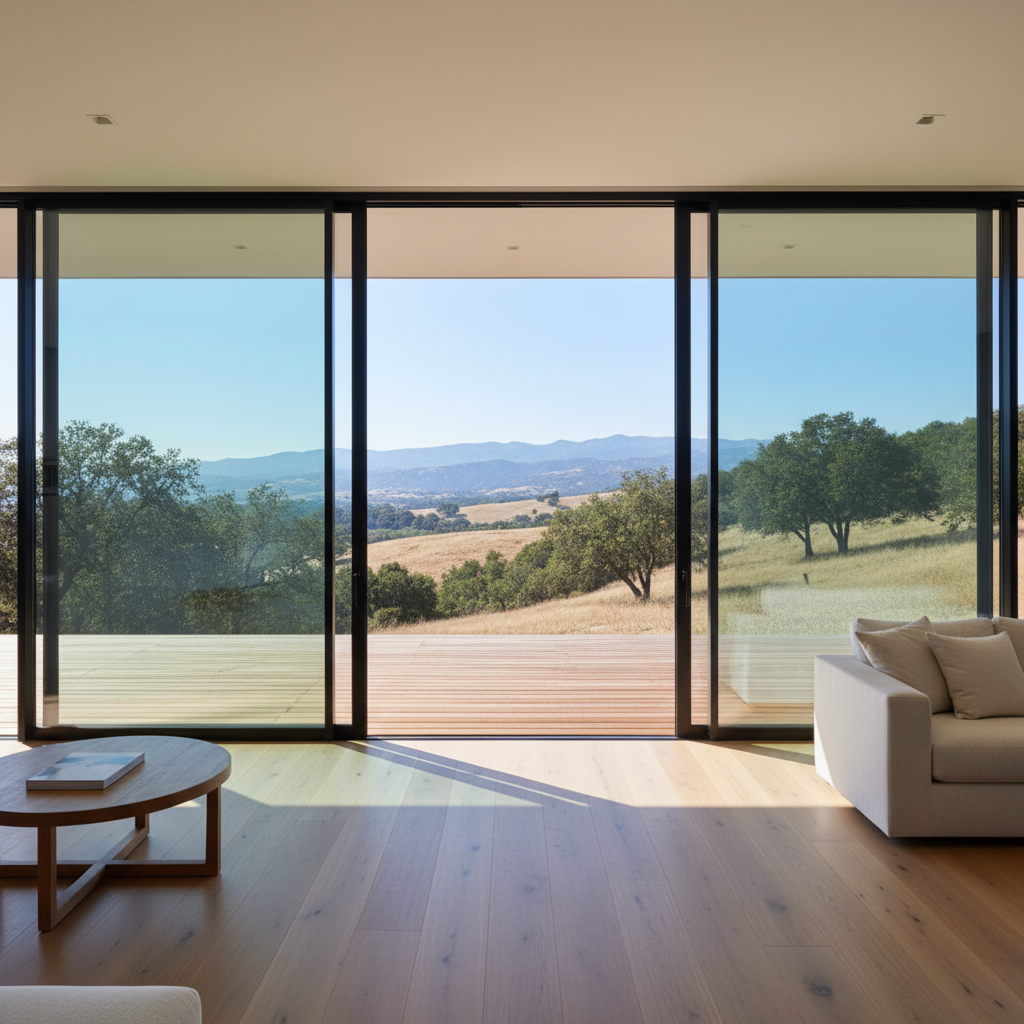
Glass garage doors cost $2,500 to $8,000 installed for a standard 16-by-7-foot two-car opening, according to pricing from major manufacturers like Clopay and Amarr along with real project data from the Colfax area. A basic single-car aluminum-frame door with clear tempered glass panels starts around $1,500 to $3,000 installed. Premium insulated models with frosted or Low-E glass, powder-coated aluminum frames, and wind-load reinforcement can push past $10,000 for custom sizes.
Those numbers put glass garage doors at roughly two to three times the cost of a traditional raised-panel steel door, which typically runs $800 to $2,500 installed for the same opening size. The price premium buys you a design element that transforms the entire front elevation of your home — plus measurable gains in natural light, curb appeal, and resale value. According to Remodeling Magazine's Cost vs. Value Report, garage door replacement is consistently among the top ROI home improvements nationwide, recovering 100 percent or more of the project cost at resale.
I'm John, owner of Colfax Glass at 226 N Auburn St in Colfax, CA. I've been working with glass, windows, and doors across the Sierra Foothills for over 25 years. While Colfax Glass does not install garage door opener systems, we work extensively with tempered and insulated glass panels, aluminum framing, and custom glass fabrication — the core components that drive glass garage door costs. This guide covers realistic 2026 pricing, the factors that move the needle on cost, and the climate-specific considerations that matter for homeowners in Colfax, Auburn, Grass Valley, and the broader I-80 corridor.
Bottom line: expect to pay $2,500 to $5,000 installed for a mid-range aluminum and glass garage door on a standard two-car opening. Insulated models with Low-E or frosted glass add $1,000 to $3,000. Custom sizes, wind-load engineering, or hurricane-rated glass can push the total past $8,000.
What Drives the Cost of a Glass Garage Door?
Glass garage doors are not a commodity product with a single price point. The total installed cost depends on five primary variables: door size, frame material, glass type, insulation, and installation complexity. Understanding how each factor affects pricing lets you compare quotes accurately and avoid surprises.
The size of the opening is the first cost driver. A standard single-car door (8 or 9 feet wide by 7 feet tall) is the least expensive starting point. A standard two-car door (16 feet wide by 7 feet tall) costs roughly 60 to 80 percent more than a single-car door — not double, because the track hardware and opener integration are similar. Custom widths or heights beyond the standard 7-foot tall opening add engineering and fabrication costs.
Frame material is the second major variable. Most glass garage doors use extruded aluminum frames because aluminum is lightweight, corrosion-resistant, and strong enough to support heavy glass panels without sagging over time. Standard mill-finish aluminum is the baseline. Powder-coated finishes in black, bronze, white, or custom colors add $200 to $600 to the door cost. Some manufacturers offer steel-framed or wood-framed glass doors, but aluminum dominates the market for good reason in the Sierra Foothills — it handles temperature swings without warping or rusting.
- Door size: single-car (8-9 ft wide) vs. two-car (16 ft wide) vs. custom width — 16-foot doors cost 60 to 80 percent more than single-car doors
- Frame material: mill-finish aluminum (baseline) vs. powder-coated aluminum (+$200 to $600) vs. steel or wood frames (less common, higher cost)
- Glass type: clear tempered (baseline), frosted tempered (+$100 to $400), Low-E tempered (+$200 to $600), laminated (+$300 to $800), or obscured/patterned (+$150 to $500)
- Insulation: uninsulated single-pane (baseline) vs. insulated dual-pane (+$800 to $2,000) — critical for climate control in attached garages
- Installation complexity: existing opening with standard tracks (baseline) vs. new opening, structural headers, or non-standard track configurations (+$500 to $2,000)
Glass Garage Door Pricing by Style and Configuration
The table below shows 2026 installed pricing ranges for the most common glass garage door configurations on a standard 16-by-7-foot two-car opening. These prices include the door, hardware, tracks, and professional installation — but not the garage door opener, which is typically a separate purchase ($250 to $600 installed).
Prices reflect national averages from Clopay, Amarr, and Wayne Dalton dealer networks, adjusted for Northern California labor rates. Your actual quote will depend on the specific manufacturer, local dealer markup, and installation conditions.
Pro Tip: if your garage is attached to the house and you use it as a workshop, gym, or living-adjacent space, the insulated dual-pane option is worth the $800 to $2,000 premium. An uninsulated glass garage door on an attached garage in Colfax will make your HVAC system work significantly harder during both summer heat and winter freezes. The energy cost difference pays back the insulation upgrade within a few years.
| Configuration | Glass Type | Insulated? | Installed Cost (16x7) |
|---|---|---|---|
| Aluminum + clear tempered | Single-pane tempered | No | $2,500 – $4,000 |
| Aluminum + frosted tempered | Single-pane frosted | No | $2,800 – $4,500 |
| Aluminum + clear insulated | Dual-pane tempered | Yes | $3,500 – $5,500 |
| Aluminum + Low-E insulated | Dual-pane Low-E | Yes | $4,000 – $6,500 |
| Aluminum + frosted insulated | Dual-pane frosted | Yes | $4,200 – $6,800 |
| Premium powder-coated + Low-E | Dual-pane Low-E | Yes | $5,500 – $8,000+ |
Insulated vs. Uninsulated: Which Makes Sense in the Sierra Foothills?
This is the decision that matters most for homeowners in Colfax and the surrounding foothill communities. According to Weather Spark, Colfax's average temperatures range from lows near 37 degrees Fahrenheit in January to highs near 89 degrees in July — a 52-degree seasonal spread. Daily swings of 30 to 40 degrees are common in spring and fall. That climate profile makes insulation a performance question, not just an efficiency question.
An uninsulated single-pane glass garage door has an R-value of roughly 0.5 to 1.0. For comparison, a traditional insulated steel garage door delivers R-8 to R-16. An insulated dual-pane glass garage door lands in the R-4 to R-8 range — not as efficient as solid insulated steel, but dramatically better than single-pane glass. For homes in the Placer County foothills where garages often share a wall with the kitchen or living room, that difference shows up directly on heating and cooling bills.
The Colfax area also sees occasional snow at the 2,400-foot elevation mark. Snow and ice buildup on an uninsulated glass door creates condensation on the interior glass surface, which drips onto the garage floor and can lead to moisture problems over time. Insulated dual-pane glass resists interior condensation because the inner pane stays closer to the garage's air temperature rather than matching the freezing exterior surface.
If you are building or remodeling and considering a glass garage door that opens to an indoor-outdoor living space — increasingly popular in California foothill homes — insulated Low-E glass is the only option that makes practical sense. The R-value, UV protection, and condensation resistance justify the $1,500 to $2,500 premium over single-pane in that application. For the same reasons, our window installation service in Colfax defaults to dual-pane Low-E glass for every residential project.
- Uninsulated single-pane: R-0.5 to R-1.0 — appropriate for detached garages used only for vehicle storage in mild climates
- Insulated dual-pane (clear or Low-E): R-4 to R-8 — recommended for attached garages, workshops, and any garage that shares a wall with living space
- Condensation risk: uninsulated glass doors in the Sierra Foothills will develop interior condensation during cold mornings, especially after overnight lows below 40 degrees Fahrenheit
- Energy impact: an uninsulated glass garage door on an attached garage can increase heating costs by 10 to 25 percent compared to an insulated option, depending on the garage's wall insulation and HVAC layout
Full View vs. Partial View: Choosing the Right Glass Layout
Glass garage doors come in two primary panel configurations: full view and partial view. The choice affects both aesthetics and cost.
Full view doors — sometimes called "all-glass" or "panoramic" doors — feature glass panels from top to bottom with minimal aluminum framing between sections. These deliver maximum natural light and a clean, modern appearance. The Clopay Avante and Amarr Vista are two of the most popular full-view models. Full-view configurations cost 10 to 20 percent more than partial-view versions of the same door because they use more glass and require stronger horizontal rails to maintain structural rigidity without solid panel sections.
Partial-view doors alternate glass panels with solid aluminum or insulated sections. The most common layout places glass in the top two or three rows with a solid bottom panel. This configuration offers better impact resistance at ground level, improved insulation values, and a lower price point. It also provides a visual break that works well on homes where a full wall of glass might feel out of proportion with the rest of the exterior.
- Full view (all-glass): maximum light, modern aesthetic, 10 to 20 percent higher cost, requires tempered safety glass in all panels per California building code
- Partial view (glass + solid panels): lower cost, better impact protection at ground level, higher insulation value, good for homes where full glass might overwhelm the facade
- Mixed configurations: some manufacturers offer customizable layouts where you choose which panel rows are glass and which are solid — useful for balancing light, privacy, and budget
Glass Options for Garage Doors: Tempered, Frosted, Low-E, and More
The glass specification is where glass garage doors intersect directly with what we do at Colfax Glass every day. Tempered glass is required by California building code (CBC Chapter 24, referencing the International Building Code) for all garage door glazing because of the risk of impact breakage. Tempered glass is four to five times stronger than regular annealed glass and breaks into small, relatively harmless granules rather than sharp shards — the same safety glazing covered in our tempered vs. laminated glass guide.
Beyond the tempered requirement, you have several options that affect appearance, privacy, and energy performance. Clear tempered glass is the most common and least expensive — it provides an unobstructed view into and out of the garage. Frosted (also called satin or obscured) tempered glass diffuses light while blocking direct sight lines, which is the preferred choice for homeowners who want natural light without exposing the garage interior to street view.
Low-E (low-emissivity) glass adds a microscopic metallic coating that reflects infrared heat while allowing visible light through. In the Sierra Foothills climate, Low-E glass reduces solar heat gain during summer and retains interior warmth during winter. Our Low-E glass guide covers the different coating types in detail. For a garage door application, Low-E is most valuable on south-facing and west-facing garage openings where direct sun exposure is highest.
- Clear tempered: maximum visibility, lowest cost, required as the baseline safety glass — good for detached garages or where the interior is kept clean and organized
- Frosted tempered: diffused light without direct visibility, popular for street-facing garages where privacy matters — adds $100 to $400 over clear
- Low-E tempered: heat-reflective coating reduces solar gain and heat loss, best for attached garages and south/west-facing openings — adds $200 to $600 over clear
- Tinted tempered: bronze, gray, or blue-green tint reduces glare and light transmission, primarily an aesthetic choice — adds $100 to $300 over clear
- Laminated tempered: combines tempered strength with a PVB interlayer for enhanced sound reduction and impact resistance — adds $300 to $800 over clear, typically used in coastal or high-wind areas
- Patterned/textured: reeded, rain, or cross-reed textures provide privacy with a decorative element — adds $150 to $500 over clear, limited availability in some door brands
Installation Cost Breakdown: Where Your Dollar Goes
A glass garage door installation is not just about the door itself. The total project cost breaks down into several components, and understanding the breakdown helps you evaluate quotes from different contractors and spot missing line items.
The door and hardware account for roughly 55 to 65 percent of the total installed price. This includes the glass panels, aluminum frame sections, hinges, rollers, tracks, springs, and weatherstripping. Professional installation — including removal and disposal of the old door, track adjustment, spring tensioning, and weatherseal installation — accounts for 25 to 35 percent. The remaining 5 to 15 percent covers structural modifications if needed, permits, and miscellaneous materials.
Structural modifications are the hidden cost that catches homeowners off guard. If you are replacing a standard 7-foot garage door with a taller 8-foot glass door — or converting a solid wall into a new garage door opening — the header beam and framing work can add $800 to $2,000 to the project. Get a structural assessment before committing to a door purchase.
| Cost Component | Percentage of Total | Typical Dollar Range (16x7) |
|---|---|---|
| Door + hardware (panels, frame, tracks, springs) | 55 – 65% | $1,500 – $5,000 |
| Professional installation labor | 25 – 35% | $600 – $1,500 |
| Old door removal and disposal | Included or $50 – $150 | $0 – $150 |
| Structural modifications (header, framing) | 0 – 15% | $0 – $1,500 |
| Permit (if required by local jurisdiction) | 1 – 3% | $75 – $250 |
| Opener upgrade (if existing opener is incompatible) | Separate | $250 – $600 |
Do You Need a Permit for a Glass Garage Door in Placer County?
In most cases, replacing an existing garage door with a new door of the same size does not require a building permit in Placer County or most Sierra Foothills jurisdictions. The replacement is considered like-for-like maintenance. However, there are several situations where a permit is required.
Changing the size of the opening — making it wider, taller, or adding a new opening where none existed — requires a building permit because it involves structural modifications to the wall and header. Converting a garage into a living space (ADU or bonus room) with a glass garage door as the primary wall opening triggers both building and planning permits. Some HOA-governed communities in Roseville, Rocklin, and parts of Auburn also require architectural review board approval for exterior changes, including garage door replacements that significantly change the home's appearance.
Placer County building permit fees for a garage door modification typically run $75 to $250 depending on the scope of work. The permit process takes one to three weeks. For more context on California permitting, our window replacement permit guide covers the general process — garage door permits follow a similar pattern.
Colfax itself, as an unincorporated Placer County community, falls under county jurisdiction. Projects in the City of Auburn, City of Roseville, or City of Rocklin require city-level permits instead of county permits, and fees and timelines vary.
How Glass Garage Doors Hold Up in the Sierra Foothills Climate
Climate durability is a legitimate concern for glass garage doors in the foothills. The I-80 corridor from Loomis to Colfax and beyond sees temperature extremes, UV exposure, wind events, and occasional snow that test every exterior building material.
Aluminum frames perform well here. Unlike steel, aluminum does not rust. Unlike wood, it does not warp, swell, or rot from moisture exposure. Powder-coated aluminum maintains its color and finish for 15 to 20 years before recoating is needed, even with the intense UV exposure common at Sierra Foothills elevations. The thermal expansion rate of aluminum is manageable — properly engineered garage door frames accommodate temperature-driven expansion and contraction without binding or seal failure.
Tempered glass panels are highly durable against hail, wind-blown debris, and normal impact. However, they are not indestructible. A direct hit from a large tree branch or a baseball will break tempered glass — just as it would break any window. The advantage is that tempered glass breaks into small granular pieces rather than dangerous shards, and individual panels can be replaced without replacing the entire door.
Snow load is a consideration for homeowners at higher elevations near Foresthill or above Colfax. A standard glass garage door is designed for normal wind loads but not for sustained snow accumulation against the panels. Homes in heavy snowfall zones should consider wind-load rated doors and ensure the door is on the downhill or sheltered side of the structure where snow does not pile against it.
- Aluminum frame durability: 20 to 30 year lifespan with minimal maintenance, no rust, no warping, powder coat lasts 15 to 20 years
- Tempered glass panels: individual panels replaceable if damaged, typical panel replacement cost $150 to $400 per section
- UV resistance: Low-E glass blocks up to 75 percent of UV radiation, protecting garage contents and reducing heat buildup
- Wind rating: standard glass garage doors handle 90 to 110 mph wind loads, impact-rated models available for exposed sites
- Snow consideration: avoid mounting on walls where snow accumulates against the door, ensure drainage directs away from the threshold
Glass Garage Doors as Indoor-Outdoor Living Features
One of the fastest-growing uses for glass garage doors in California has nothing to do with parking cars. Homeowners across the Sierra Foothills and the broader Sacramento region are installing glass garage doors as indoor-outdoor living walls — in patio rooms, pool houses, workshops, ADUs, and home gyms.
When a glass garage door is fully open, it creates a seamless transition between indoor and outdoor space that no sliding glass door or French door system can match. A 16-foot-wide opening eliminates the wall entirely. When closed, the insulated glass panels provide weather protection while maintaining the visual connection to the outdoors. This dual-purpose functionality is why glass garage doors appear in architectural magazines and design shows — and why demand has grown steadily.
For this application, insulated Low-E glass is essential. The door functions as an exterior wall for a conditioned space, so R-value, air sealing, and solar heat gain coefficient all matter. A bottom weatherseal rated for the application prevents water intrusion during rain. These living-space installations also benefit from quiet-operation upgrades: belt-drive openers instead of chain-drive, nylon rollers instead of steel, and insulated tracks to reduce metal-on-metal noise.
If you are considering this type of installation for a remodel or new construction project in the Colfax area, a glass and glazing consultation before you commit to a door specification can save you from expensive mid-project changes. We help homeowners and contractors select the right glass type, frame finish, and insulation spec for the intended use.
How to Compare Quotes and Avoid Overpaying
Glass garage door pricing varies significantly between dealers and installers. A 20 to 30 percent spread between the lowest and highest quote for the same door on the same opening is common. Here is how to compare quotes on an equal basis and catch the line items where costs hide.
First, confirm that every quote specifies the exact same door model, glass type, and insulation level. "Aluminum and glass garage door" is not a specification — it is a category. Two quotes that both say "16x7 aluminum glass door" could be comparing a $2,000 uninsulated single-pane door against a $5,000 insulated Low-E door. Get the manufacturer name, model number, glass specification, and finish in writing on every quote.
Second, check what installation includes. A complete installation quote should cover removal of the existing door, installation of new tracks and hardware, spring tensioning, weatherseal installation, and cleanup. Some installers quote the door price only and add installation as a separate line item. Others include installation but charge extra for old door removal and disposal.
Pro Tip: glass garage doors weigh 30 to 50 percent more than traditional steel doors of the same size. If your existing garage door opener is more than 10 years old or rated below 1/2 horsepower, it almost certainly needs to be replaced when you upgrade to a glass door. Budget an additional $300 to $600 for an opener upgrade — it is cheaper to replace it during the door installation than to do it as a separate service call later.
- Get at least three quotes from different dealers or installers
- Require manufacturer name, model number, glass type, insulation spec, and frame finish on every quote
- Confirm installation scope: old door removal, new track installation, spring tensioning, weatherseal, cleanup
- Ask about warranty: door manufacturer warranty (typically 5 to 10 years) plus installer workmanship warranty (typically 1 to 2 years)
- Check if the opener is compatible — glass doors are heavier than steel doors and may require a higher-horsepower opener ($250 to $600 if an upgrade is needed)
- Ask about lead time — custom sizes and finishes can take 4 to 8 weeks for delivery, stock sizes ship in 1 to 2 weeks
Maintenance: Keeping a Glass Garage Door Looking Good
Glass garage doors require more visible maintenance than traditional steel doors, but the actual effort is minimal. The glass panels show dirt, water spots, and fingerprints more readily than a painted steel surface. A quarterly cleaning schedule keeps the door looking sharp year-round.
For the glass panels, a standard window cleaning solution and a squeegee work well. Avoid pressure washers on the glass — the high-pressure stream can damage the weatherstripping and seals between panels. For the aluminum frame, a soft cloth with mild soap and water removes oxidation buildup. Avoid abrasive cleaners or steel wool on powder-coated finishes.
The mechanical components — tracks, rollers, springs, and hinges — follow the same maintenance schedule as any garage door. Lubricate the tracks and rollers with a silicone-based lubricant twice a year. Check spring tension annually. Inspect weatherstripping at the bottom and sides for wear and replace it when it no longer makes full contact with the floor and frame. In the Sierra Foothills, the bottom weatherseal takes the most abuse from temperature cycling and occasional snow or ice contact.
- Glass cleaning: quarterly with standard glass cleaner and squeegee — avoid pressure washers
- Frame cleaning: quarterly with mild soap and water — no abrasive cleaners on powder coat
- Track and roller lubrication: twice annually with silicone-based lubricant
- Spring inspection: annually by a qualified technician — garage door springs are under extreme tension and should not be adjusted by homeowners
- Weatherseal check: annually, replace bottom seal every 3 to 5 years or when it no longer contacts the floor evenly
- Hardware check: tighten hinges, brackets, and roller stems annually — vibration loosens fasteners over time
Getting a Glass Garage Door Quote in the Colfax Area
Glass garage doors involve both a door component (manufactured by companies like Clopay, Amarr, or Wayne Dalton) and a glass component that directly overlaps with the work Colfax Glass does every day. If you are planning a glass garage door project and need guidance on glass type selection, tempered glass specifications, or custom glass fabrication for a non-standard panel size, we can help with that part of the project.
For homeowners considering a glass garage door as part of an indoor-outdoor living conversion, ADU build, or major remodel, we offer glass and glazing consultation to help you and your contractor spec the right glass product for the application. This is particularly important in the Sierra Foothills, where insulation requirements, UV exposure, and temperature extremes eliminate some glass options that would work fine in a milder climate.
Colfax Glass serves homeowners throughout the I-80 corridor — Colfax, Auburn, Grass Valley, Nevada City, Foresthill, Loomis, Rocklin, Roseville, and Sacramento — as well as coastal communities in Brookings and Crescent City. Request a free consultation or call 530-545-1385 to discuss your glass garage door project.